
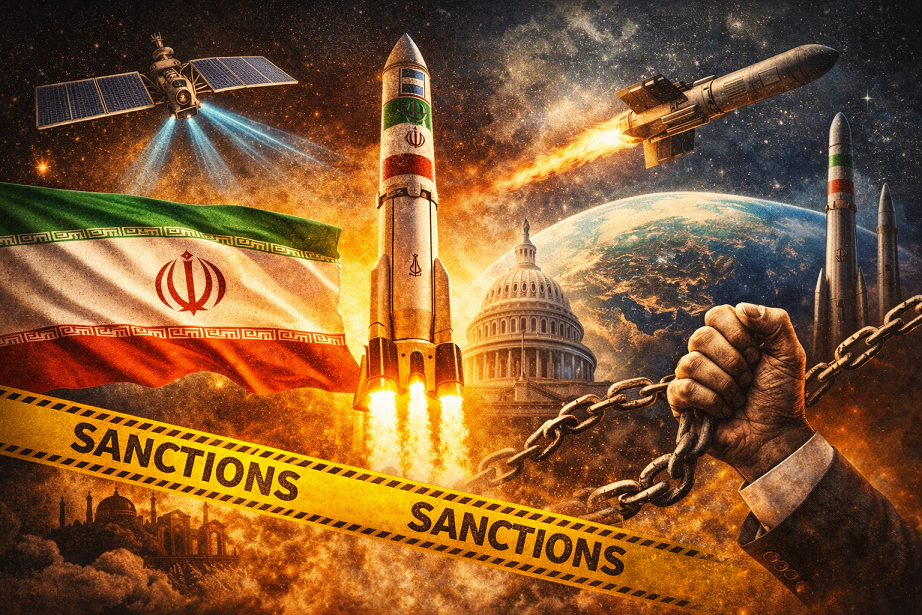
For decades, Iran was portrayed as technologically isolated—cut off from Western innovation by sanctions, restrictions, and political hostility. Yet today, quietly and persistently, Tehran is building something that many of its critics hoped it never would: indigenous space and satellite capability.
This is not just about science. It is about power, independence, and leverage—and it is changing the strategic equation in the Middle East and beyond.
From Sanctions to Satellites
Iran’s gradual establishment of satellites marks one of the most under-discussed shifts in global technology politics. Despite facing some of the toughest sanctions regimes in modern history, Iran has managed to design satellites, develop launch vehicles, and place payloads into orbit—sometimes independently, sometimes with limited cooperation from non-Western partners like Russia.
Recent launches involving satellites such as Nahid-2, Kawthar, and other remote-sensing platforms signal a clear trajectory: Iran is no longer experimenting; it is institutionalizing its space program.
Western governments may dismiss these launches as symbolic or “low-resolution,” but symbolism matters. Every successful satellite reduces Iran’s dependence on Western systems—and that, more than the satellites themselves, is what alarms Washington and its allies.
Technological Independence: Breaking the Western Monopoly
Satellite technology is among the most tightly controlled sectors in the world. Navigation systems, earth observation, encrypted communications, and real-time data analysis have long been dominated by Western or Western-aligned powers.
Iran’s progress directly challenges this monopoly.
By developing indigenous satellites, Iran gains:
- Independent access to geospatial data
- Reduced reliance on foreign GPS, weather, and imaging services
- Domestic expertise in advanced electronics, propulsion, and systems engineering
This is technological sovereignty in action. And it sends a message many developing nations understand clearly: sanctions do not necessarily stop innovation—they often redirect it.
Economic Payoff Beyond Propaganda
Critics often label Iran’s space ambitions as propaganda tools. That argument ignores economic reality.
Satellite data fuels:
- Precision agriculture
- Disaster forecasting
- Water and climate monitoring
- Telecommunications expansion
- Urban planning and infrastructure development
For an economy under pressure, satellite-driven data services offer Iran something sanctions cannot easily block: internal efficiency and future commercial potential. Over time, this capability could support regional data services for allied states, creating a parallel technological ecosystem outside Western control.
The Military Question No One Can Ignore
Here lies the controversy.
While Iran insists its space program is peaceful, Western analysts argue—correctly—that space and missile technologies share overlapping foundations. Launch vehicles, guidance systems, propulsion stages, and telemetry expertise are inherently dual-use.
From a security perspective, satellites provide:
- Enhanced surveillance and reconnaissance
- Secure military communications
- Strategic early-warning potential
This does not automatically mean weaponization—but it undeniably raises Iran’s strategic depth. For Israel and Gulf states, this is not theoretical. It alters threat perception, deterrence calculations, and regional military planning.
The uncomfortable truth is this: space capability equals strategic credibility. And Iran is steadily acquiring it.
Redrawing the Middle East Power Map
Iran’s satellite progress does not exist in isolation. It coincides with:
- Growing Iran-Russia technological cooperation
- Expanding China-Middle East engagement
- Fragmentation of U.S. dominance in the region
As regional rivals invest heavily in space and surveillance, Iran’s entry into this domain prevents technological asymmetry. It signals that Tehran intends to compete not only through proxies and diplomacy—but through hard technology.
This shifts Iran’s image from a sanctioned outlier to a resilient, adaptive power capable of surviving—and even advancing—under pressure.
Global Politics: A Dangerous Precedent or a New Reality?
For the West, Iran’s space success presents an uncomfortable precedent. If a heavily sanctioned state can still develop satellite capability, what does that say about the effectiveness of technology containment policies?
For the Global South, however, the lesson is different: technological independence is possible outside Western approval structures.
That is why Iran’s satellites matter far beyond Tehran.
They represent a slow erosion of a world order where access to advanced technology is controlled by a handful of powers.
Conclusion: Why This Matters More Than Missiles
Iran’s satellites are not about reaching the stars. They are about escaping dependence.
Each successful launch weakens the assumption that sanctions guarantee stagnation. Each satellite in orbit strengthens Iran’s bargaining position—economically, militarily, and diplomatically.
Whether admired or feared, one reality is clear:
Iran is no longer just resisting the system—it is learning how to operate beyond it.
And in today’s world, that may be the most powerful technology of all.