
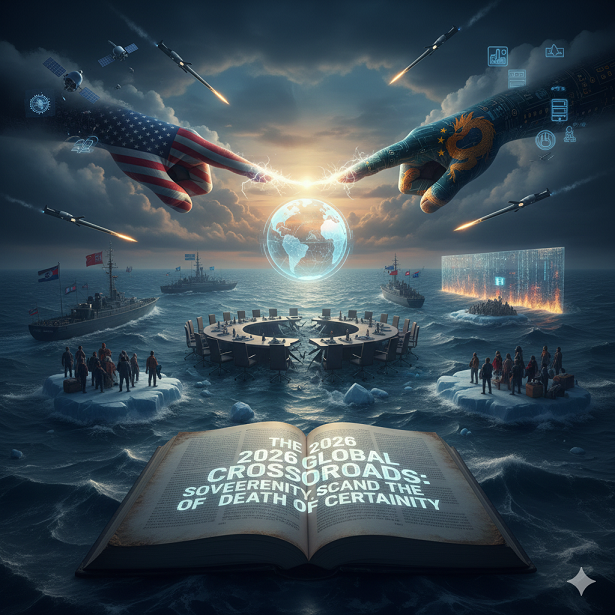
As 2025 draws to a close, the world isn’t just turning a page on a calendar—it is closing a chapter on the “Old World Order.” The comfortable political maps of the past are dissolving. In their place is a churning, multipolar sea where technology, climate, and raw power are colliding to create a “New Unpredictability.”
Here is what the geopolitical storm of 2026 looks like and why the stakes have never been higher.
1. The Death of Borders: Sovereignty in a Digital Mist
The most controversial shift of 2026 isn’t a physical invasion; it’s the erosion of the “National Border.” By now, warfare has moved into the wires. State-sponsored hackers operate in the shadows, targeting everything from power grids to the very trust we place in democracy.
- The “Cyber-Sovereignty” Wall: Expect nations to begin “walling off” their digital spaces. This isn’t just about security—it’s digital protectionism.
- The Attribution Trap: When a country’s financial system collapses due to a hack, but no one claims responsibility, how do you retaliate? This ambiguity is the new frontline.
2. The Great Thirst: Resource Nationalism & Climate Chaos
Climate change is no longer a “future” threat—it is the primary driver of 2026’s migration crisis. We are entering the era of Resource Nationalism.
- The Arctic Gold Rush: As polar ice thins, the scramble for shipping routes and rare earth minerals is turning the North into a high-stakes chessboard.
- The Migration Tsunami: Millions are fleeing unlivable heat and failed crops in the Global South. This isn’t just a humanitarian issue; it is a political firebrand that is fueling xenophobia and reshaping elections across Europe and North America.
3. Transactional Diplomacy: The End of “Forever Friends”
The days of “shared values” and decades-long alliances are fading. In 2026, diplomacy is purely transactional.
Countries are no longer asking, “Is this ally a democracy?” Instead, they are asking, “What have you done for me today?” This shift makes global governance incredibly fragile. International bodies like the UN are struggling to remain relevant as nations opt for “mini-lateral” deals—small, ad-hoc groups focused on immediate profit rather than long-term stability.
4. The Titan’s Duel: The US-China Decoupling
The rivalry between Washington and Beijing has entered its most dangerous phase yet: Technological Divorce.
- The Silicon Shield: The race for advanced AI and semiconductors isn’t just about business; it’s about military survival.
- A Divided World: Smaller nations are increasingly being forced to pick a side—not just politically, but technologically. Do you use the US internet or the Chinese one? Do you use Western satellite systems or Eastern ones?
5. AI and the “Invisible” Arms Race
Finally, 2026 introduces a terrifying new player: Autonomous Weaponry. The introduction of AI into decision-making on the battlefield has outpaced international law.
The fear of a “First-Mover Advantage” is driving a secret arms race. If an AI system decides to escalate a conflict in milliseconds, can a human leader ever hope to de-escalate it in time? The ethical debate is raging, but the technology is already in the field.
The Verdict
The year 2026 will be a crucible. We are witnessing the birth of a world that is more connected by technology but more divided by ideology. The “tempest” isn’t coming—it’s already here. Our survival depends on whether we choose to build better dikes or simply try to outswim each other.