
Is the United States Losing Its Moral Authority as a Peace Broker?
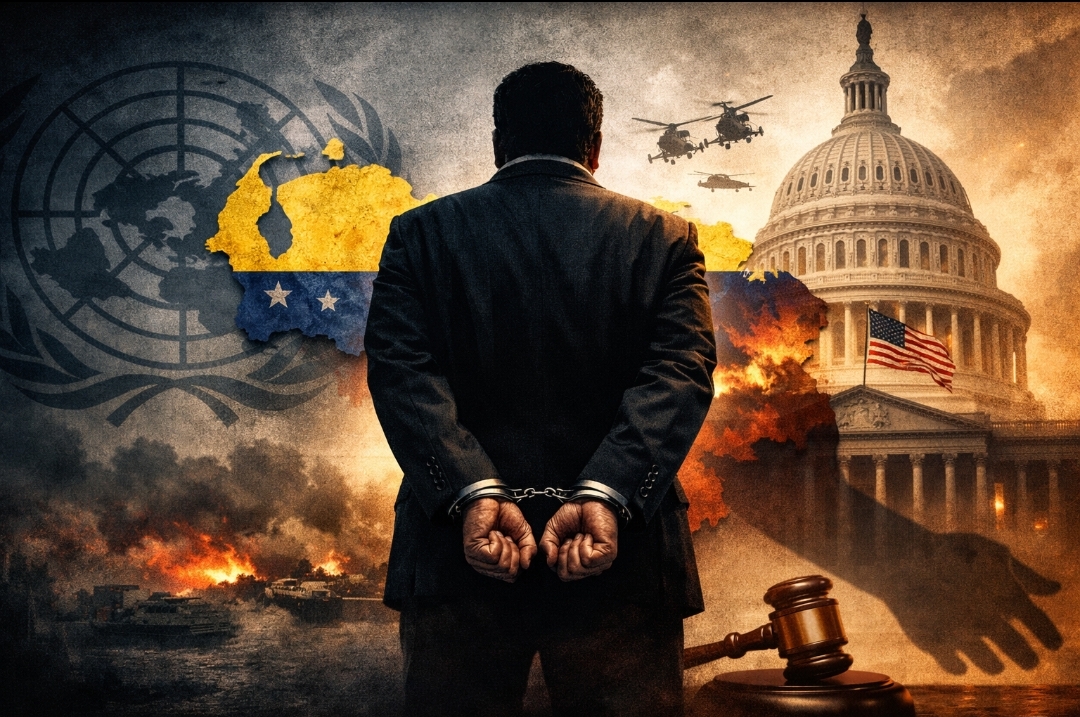
The arrest of Venezuela’s sitting President by the United States has sent shockwaves across the international system, triggering intense debate over sovereignty, legality, and the future of global order. Rarely in modern history has a global power detained the head of state of another sovereign nation through direct intervention. While Washington defends the move as a matter of justice and security, the broader implications raise uncomfortable questions about international law and the declining credibility of the United States as a neutral peace-maker.
At the heart of the controversy lies the principle of state sovereignty, a cornerstone of the post-Second World War international system. The United Nations Charter strictly limits the use of force against another state, allowing it only in cases of self-defense or with explicit authorization from the UN Security Council. The unilateral arrest of a sitting president, carried out beyond U.S. territory and without multilateral approval, challenges these foundational norms.
Supporters of the U.S. action argue that grave allegations—ranging from organized crime to threats against international security—justify extraordinary measures. However, international law does not operate on selective morality. If accusations alone become sufficient grounds for cross-border arrests of national leaders, the world risks sliding into a system where power overrides law. Today it is Venezuela; tomorrow it could be any nation whose leadership conflicts with the interests of a stronger state.
The reaction from much of the Global South has been one of deep unease. For many countries in Latin America, Africa, and Asia, the incident revives historical memories of foreign intervention disguised as moral or legal necessity. These states fear that such actions normalize a dangerous precedent, where judicial claims are enforced through military or coercive means rather than international consensus.
This event also exposes a widening contradiction in U.S. foreign policy. For decades, Washington has positioned itself as a defender of the rules-based international order, advocating diplomacy, mediation, and peaceful conflict resolution. Yet actions like this undermine that narrative. A peace-maker is expected to uphold institutions, not bypass them; to strengthen global norms, not stretch them to their limits.
The damage to U.S. credibility may extend far beyond Latin America. Rival powers are likely to use this episode to justify their own unilateral actions, pointing to Washington’s behavior as evidence that international law is applied selectively. In such an environment, multilateral institutions risk becoming weaker, while geopolitical competition becomes more aggressive and unpredictable.
There are also domestic and legal questions within the United States itself. Critics argue that operations of this magnitude demand broader political oversight and international consultation. Without transparent legal grounding, even actions claimed to be in the name of justice can appear arbitrary, eroding trust both at home and abroad.
From a geopolitical perspective, the arrest could accelerate shifts in global alliances. Countries wary of U.S. interventionism may seek closer ties with alternative power centers, further fragmenting the international system. Instead of isolating adversaries, unilateral force may end up isolating the very actor that deploys it.
Most concerning is the long-term impact on international law itself. Laws survive not merely through enforcement, but through mutual respect and restraint. When powerful states bypass agreed frameworks, smaller states lose faith in global institutions meant to protect them. The result is a more insecure world, where power politics dominate over diplomacy.
In conclusion, the arrest of Venezuela’s president marks a critical moment for global governance. Regardless of the individual in question or the allegations involved, the method chosen carries consequences that extend far beyond one country. If the international community fails to address the legal and ethical implications, this incident may be remembered as another step toward the erosion of a rules-based world order.
For the United States, the challenge ahead is clear: reclaim credibility not through force, but through leadership rooted in law, multilateralism, and restraint. Without that, its long-standing role as a global peace broker risks becoming a title of the past rather than a responsibility of the present.