
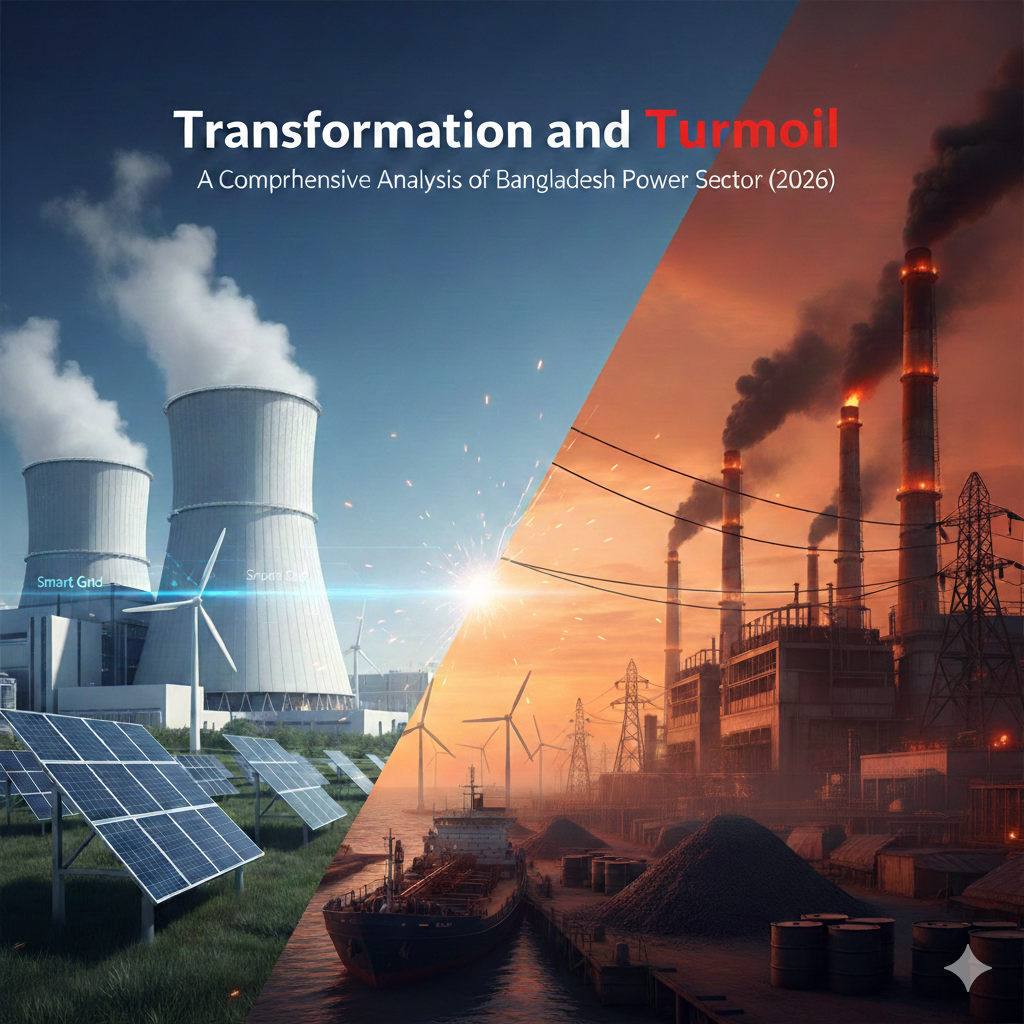
Transformation and Turmoil: A Comprehensive Analysis of the Bangladesh Power Sector (2026)
As of early 2026, Bangladesh’s power sector presents a duality of historic achievement and systemic crisis. While the nation has achieved 100% electrification, the sector is currently paralyzed by massive financial liabilities, fuel supply insecurities, and the legacy of non-competitive procurement. This paper explores the transition from the “access-focused” era (2009–2023) to the current “stability-focused” era (2024–2026), analyzing the impact of capacity charges, corruption under special laws, and the burgeoning potential of nuclear and renewable energy.
1. Introduction: The Price of Rapid Expansion
Since 2009, Bangladesh’s power sector has been the most visible indicator of its economic trajectory. The installed capacity surged from approximately 4,942 MW to an unprecedented 32,322 MW by December 2025. This expansion fueled a decade of 6-7% GDP growth. However, the strategy relied heavily on “Quick Rental” plants and imported fossil fuels, creating a high-cost structure that is no longer sustainable under the current global economic climate and domestic dollar shortages.
2. Power Generation Dynamics and Fuel Mix
The energy landscape is shifting from a gas-dominated monoculture to a diversified, yet import-dependent, mix. As of January 2026, the reliance on domestic natural gas has dwindled due to depleting reserves, forcing a pivot toward coal and LNG.
2.1 Installed Capacity vs. Maximum Demand
A persistent issue in 2026 is the gap between “installed” capacity and “actual” demand. While the country boasts over 32,000 MW of capacity, the maximum demand served peaked at only 16,794 MW in July 2025. This “overcapacity” is not a surplus of usable power, but rather a surplus of idle machinery for which the state pays a heavy price.
Table 1: Power Generation Snapshot (January 2026)
| Metric | Details |
|---|---|
| Total Installed Capacity | 32,322 MW (Incl. Captive & Off-grid) |
| Grid-based Capacity | 28,909 MW |
| Maximum Demand Served (2025) | 16,794 MW |
| Reserve Margin | ~48% (Theoretical) |
| Current Electrification Rate | 100% |
2.2 The Fuel Mix Transition
The dominance of natural gas has fallen from nearly 90% in 2010 to roughly 44% in 2026. Coal and liquid fuels (HFO/HSD) have filled the gap, alongside an increasing share of imported power from India.
Table 2: Fuel Mix for Grid-Based Generation (January 2026)
| Fuel Type | Capacity (MW) | Share (%) |
|---|---|---|
| Natural Gas | 12,512 | 44.1% |
| Coal | 7,179 | 25.3% |
| Heavy Fuel Oil (HFO) | 5,641 | 19.9% |
| Imported (India) | 1,160 | 4.1% |
| Solar/Wind/Hydro | 1,059 | 3.7% |
| Diesel (HSD) | 768 | 2.7% |
3. The Economics of Subsidy and Corruption
The financial health of the Bangladesh Power Development Board (BPDB) is at an all-time low. The primary culprit identified by the 2025 “White Paper on the State of the Economy” is the systemic drain caused by Capacity Charges.
3.1 The “Indemnity” Legacy
For over a decade, the Quick Enhancement of Electricity and Energy Supply (Special Provision) Act 2010 bypassed competitive bidding. This allowed the government to sign “Take-or-Pay” contracts with private power producers (IPPs).
- Capacity Payments: Between 2010 and 2025, the government paid over Tk 1.4 trillion (approx. $12-14 billion) in capacity charges to plants that often sat idle.
- Fiscal Burden: In the FY2025–26 budget, the power sector required a subsidy of Tk 37,000 crore, accounting for nearly 41% of the total national subsidy allocation.
3.2 Corruption and Institutionalized Inefficiency
Recent reports from Transparency International Bangladesh (TIB) in late 2025 highlight that corruption in the sector has moved from simple bribery to “policy capture” by a fossil fuel lobby. This lobby has successfully marginalized renewable energy projects to protect the interests of coal and oil-based plant owners.
4. Key Challenges in 2026
- Fuel Supply Insecurity: The reliance on imported LNG and coal makes the sector vulnerable to global price shocks. Domestic gas production remains stagnant at around 2,000-2,300 mmcfd against a demand of 4,000 mmcfd.
- Transmission Bottlenecks: While generation capacity is high, the transmission grid cannot support the full load. Significant parts of the 400kV and 230kV lines are underutilized due to missing “last-mile” connectivity.
- Dollar Crunch: Releasing payments to foreign IPPs and buying fuel remains difficult due to restricted foreign exchange reserves, leading to coal-shipment delays at plants like Payra and Matarbari.
5. Prospects: The Nuclear and Green Horizon
Despite the challenges, 2026 marks a turning point for two major “clean” energy pillars.
5.1 The Nuclear Leap: Rooppur
The Rooppur Nuclear Power Plant (RNPP) is the most significant project in the nation’s history.
- Status: Unit 1 (1,200 MW) is expected to begin commercial operation by late 2026.
- Impact: It will provide “base-load” power at a relatively stable price, reducing the need for erratic LNG imports.
5.2 The Renewable Shift
Under the Integrated Energy and Power Master Plan (IEPMP), the goal is to reach 6,000 MW of renewable capacity by 2030.
- Solar Parks: Large-scale projects like the Teesta 200MW solar park are setting a precedent.
- Wind Energy: The Cox’s Bazar 60MW wind farm has proven the feasibility of wind energy in the coastal belt.
6. Recommendations for Reform
To stabilize the sector, the following structural reforms are essential:
- “No Power, No Payment”: All future and renewed contracts must eliminate fixed capacity charges, shifting to a “pay-as-you-go” model.
- Competitive Bidding: Reinstating the requirement for open tenders for all new power and energy projects.
- Grid Modernization: Prioritizing investment in “Smart Grids” to reduce technical system losses, which still hover around 7-8%.
- Regional Integration: Expanding the cross-border grid to import cheap hydropower from Nepal and Bhutan.
7. Conclusion
The power sector of Bangladesh has successfully transitioned from a state of “darkness” to “excess capacity.” However, the lack of transparency and economic foresight has turned this success into a fiscal trap. As 2026 progresses, the success of the Rooppur Nuclear plant and the aggressive pursuit of renewable energy will determine whether Bangladesh can provide the affordable, reliable, and clean energy required for its “Vision 2041.”
References
- Bangladesh Power Development Board (2025). Annual Report FY 2024-25.
- Centre for Policy Dialogue (CPD, 2025). Power and Energy Sector in the National Budget FY25-26: Reflections on Priorities.
- Transparency International Bangladesh (2025). Generating Power from Renewable Energy: Governance Challenges.
- World Nuclear Association (2026). Nuclear Power in Bangladesh: Status Report January 2026.
- Ministry of Finance (2025). White Paper on the State of the Bangladesh Economy.