
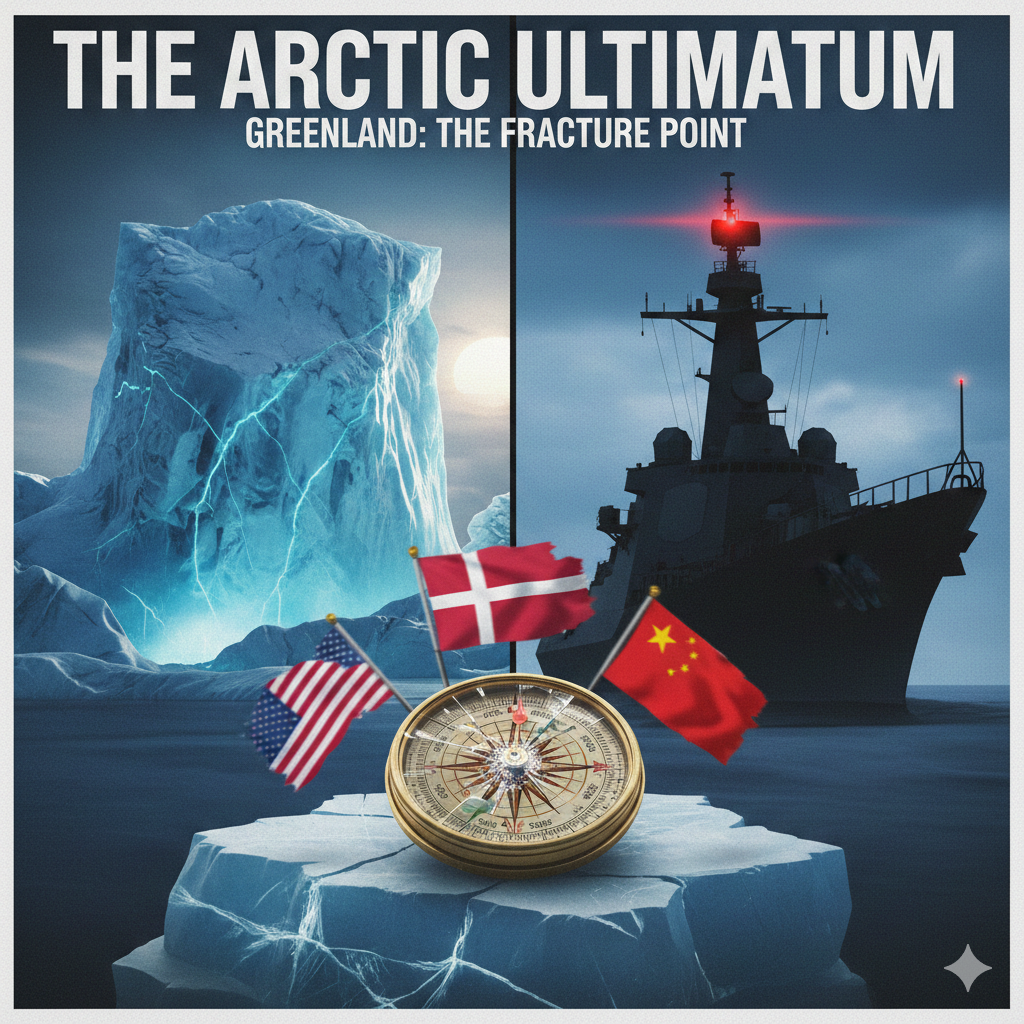
In January 2026, the world finds itself at a geopolitical precipice. What was once dismissed as a peripheral real estate interest has evolved into the Greenland Crisis, a flashpoint that threatens to dismantle 75 years of transatlantic security and redefine the global order.
1. The Crucible: Why Greenland, Why Now?
As of 2026, the Arctic is no longer a “frozen buffer.” Climate change has accelerated at an alarming rate, transforming the region from an inaccessible wasteland into a strategic goldmine.
- The Resource Rush: Beneath the thinning ice sheets lie the world’s largest untapped deposits of rare-earth elements. These minerals are the lifeblood of 21st-century technology—from electric vehicle batteries to hypersonic missile guidance systems.
- The New Silk Road: With the “Northwest Passage” becoming seasonally navigable, shipping times between Asia and Europe are being slashed by 40%, bypassing the congested Suez Canal.
- The Missile Shield: Greenland sits directly under the shortest flight path for nuclear missiles between Eurasia and North America. It is the ultimate “high ground” for early-warning systems and satellite surveillance.
2. The Brink of WWIII: Alliances and Fault Lines
The crisis reached a boiling point in early January 2026, following President Trump’s renewed declarations that US control of Greenland is a “strategic imperative.” For the first time, the threat of military annexation has been openly discussed in Washington, triggering a chain reaction of global mobilization.
The Possible Sides:
| Bloc | Primary Members | Strategic Goal |
|---|---|---|
| The Resistance | Denmark, EU, NATO (majority) | Defend Greenlandic sovereignty and the UN Law of the Sea. |
| The Unilateralists | United States | Secure the Arctic as a “National Security Zone” to block rivals. |
| The Opportunists | Russia & China | Exploit the rift in NATO to expand their own Arctic influence. |
Danish Prime Minister Mette Frederiksen has been blunt: “If America used force against Greenland, NATO would cease to exist.” This isn’t hyperbole. If the US moves against a fellow NATO member (Denmark), the core treaty of “all for one” collapses, potentially inviting a Russian advance into Eastern Europe or a Chinese move in the South China Sea.
3. The End of American Hegemony?
The Greenland Crisis marks a historic shift in how the world views American leadership.
- Loss of Moral Authority: By threatening to annex the territory of a historic ally, the US is transitioning from a “Global Leader” to a “Unilateral Power.” This has triggered a massive US-EU trade war, with the IMF warning of a “spiral of escalation” that could collapse global markets.
- The Rise of a Multipower World: As the US alienates Europe, we are seeing the emergence of a “European Strategic Autonomy.” France and Germany are already drafting independent defense plans, no longer relying on the American nuclear umbrella.
- Who Takes Over? No single nation is ready to replace the US. Instead, we are entering a Polycentric Era. China is positioning itself as the champion of “multilateralism” (despite its own territorial ambitions), while a unified European bloc is emerging as a third pole in global politics.
4. Global Impact: Beyond the Politics
The crisis isn’t just about maps; it’s about survival.
- Climate Tipping Point: If political tensions lead to unregulated mining and military industrialization in Greenland, we risk hitting a “tipping point.” A total melt of the Greenland Ice Sheet would raise global sea levels by 7.4 meters (23 feet), effectively erasing coastal cities like New York, Mumbai, and Amsterdam.
- Economic Chaos: Gold and silver have hit record highs this week as investors flee the US dollar, fearing the “Greenland Tax” and retaliatory tariffs from the EU.
Conclusion: A World at a Crossroads
Greenland is no longer just an island; it is the “canary in the coal mine” for the 21st century. The outcome of this crisis will determine whether the future is governed by international law or by the “might makes right” philosophy of the 19th century.
If the US proceeds with its “America First” Arctic policy, it may gain a strategic island but lose the world.