
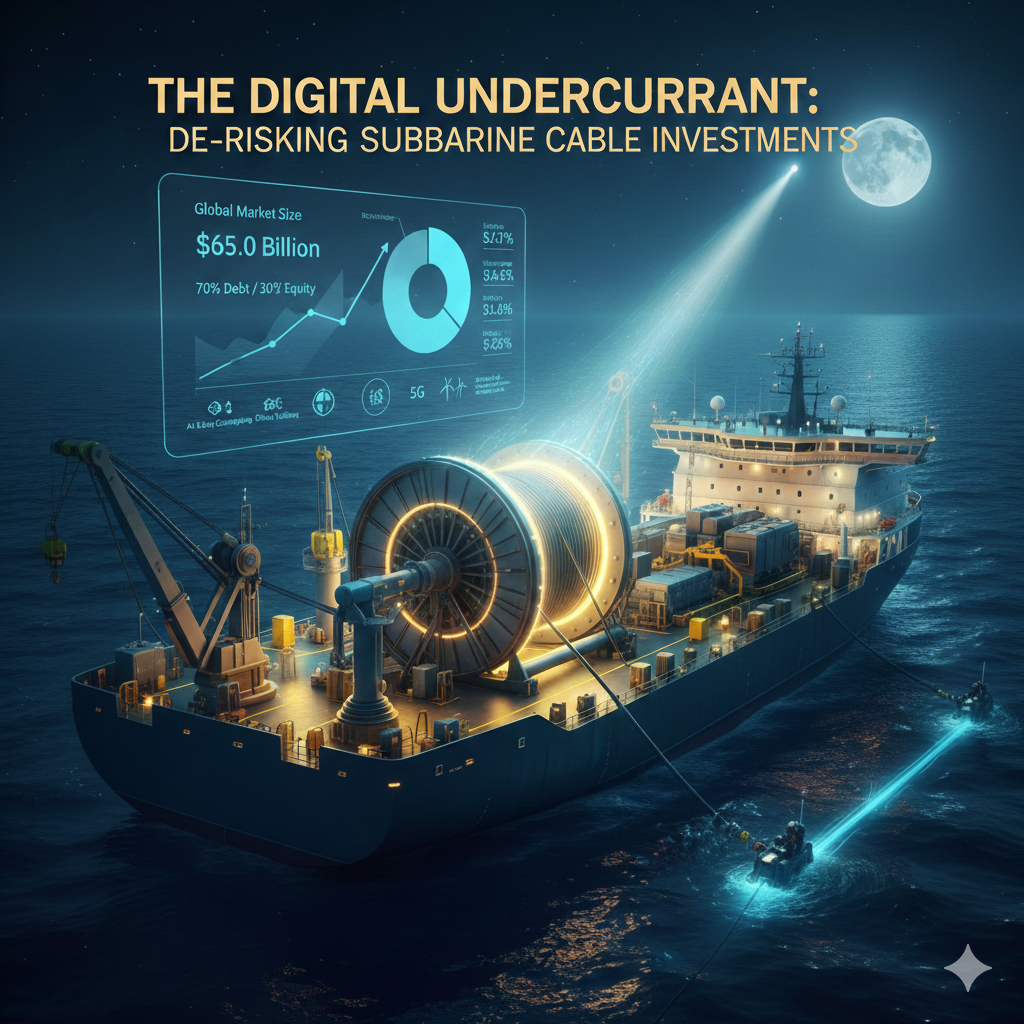
In the global financial landscape, “the cloud” has a physical home: the ocean floor. Submarine fiber-optic cables now carry 99% of all international data transfers. For institutional investors and project finance desks, this sector has evolved from a niche telecom utility into a high-yield, mission-critical infrastructure asset class essential for the AI-driven global economy.
I. Market Valuation and Growth Super-Cycle (2026–2035)
The global submarine cable system market is valued at $26.1 billion in 2026 and is projected to skyrocket to $55.3 billion by 2034. This growth is driven by a “Super-Cycle” of AI training, edge computing, and the replacement of aging 20th-century cables.
II. Financial Blueprint: A Hypothetical $150 Million Project
To assist in investment appraisal, we analyze “Project Aqua-IX,” a hypothetical $150 million private subsea link connecting the emerging South Asian digital hub to Singapore.
1. Capital Expenditure (CAPEX) Segmentation
Asset valuation in subsea projects is divided into “Wet” and “Dry” plants.
| Component | Cost (USD) | Percentage | Description |
|---|---|---|---|
| Wet Plant | $105.0 Million | 70% | 2,500km cable, 35 repeaters, marine burial. |
| Dry Plant | $30.0 Million | 20% | Landing stations, terminal equipment (SLTE). |
| Soft Costs | $15.0 Million | 10% | Surveys, permitting, and legal/regulatory. |
2. Funding and Debt Dynamics
Bankers typically favor a 70:30 Debt-to-Equity (D/E) ratio.
- Syndicated Debt ($105M): Lenders (such as HSBC, Standard Chartered, and Eastern Bank) look for “Anchor Tenants”—hyperscalers like Google or Meta—who pre-purchase capacity via Indefeasible Rights of Use (IRU) contracts to secure the loan.
- Equity ($45M): Sourced from private consortia like Summit Communications or Metacore Subcom, who seek high Internal Rates of Return (IRR).
III. Private vs. State Models: The Case of Bangladesh
The industry is shifting from state monopolies to agile private partnerships.
- The Private Disruptor (Summit/BPCS): A consortium of three private companies is currently investing $110 million in the country’s first private cable. By bypassing state-run bureaucracy, they offer lower latency and integrated terrestrial fiber “tails” for end-to-end delivery.
- The State Incumbent (BSCPLC): While historically dominant, Bangladesh Submarine Cables PLC saw a 22.7% revenue dip in FY24 due to global tariff price wars and unforeseen cable cuts in the Indonesian maritime area.
IV. Risk Matrix for Investment Committees
Banking due diligence must address three high-impact “leakage” points:
- Physical Vulnerability: 25% of faults are caused by anchor drags. Mitigation: Heavy armoring and deep burial (2+ meters).
- Geopolitical Friction: Data sovereignty laws and territorial disputes can stall projects. Mitigation: Multi-path redundancy and landing in neutral jurisdictions.
- Currency Mismatch: CAPEX is USD-based, while local revenues are often in BDT or other local currencies. Mitigation: USD-indexed wholesale contracts.
V. Financial Projections: The “J-Curve” of Returns
For a $150 million project, the typical Payback Period is 6–8 years.
- Year 1-2: Heavy negative cash flow (Construction).
- Year 3-5: Exponential revenue growth as “Lit-up Capacity” utilization climbs to 90%.
- EBITDA Margin: Once operational, margins typically stabilize at 75%–85% due to low ongoing OPEX (less than 6% of CAPEX annually).
Conclusion for the Investment Committee
Submarine cables are the “Digital Real Estate” of 2026. While the upfront CAPEX is significant, the recurring revenue from Global Content Providers (GCPs) and the critical nature of the infrastructure provide a unique defensive growth opportunity.