
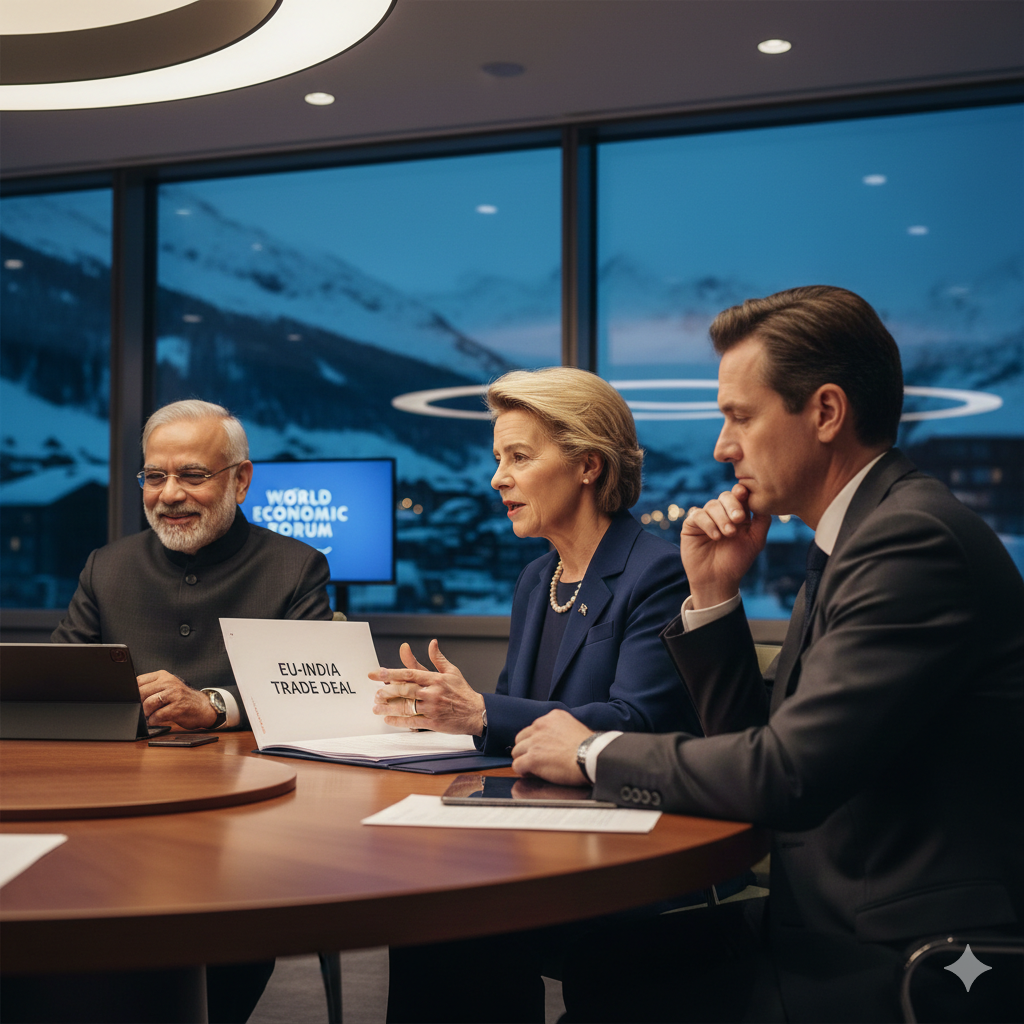
The World Economic Forum (WEF) Annual Meeting 2026, held from January 19–23 in Davos-Klosters, Switzerland, convened nearly 3,000 leaders under the theme “A Spirit of Dialogue.” Against the most complex geopolitical backdrop in decades, the summit functioned as a critical platform for addressing what leaders termed an “Age of Competition,” where long-held assumptions about security, sovereignty, and global integration are being fundamentally re-evaluated.
1. Global Economic Outlook: “Steady amid Divergent Forces”
The 2026 summit opened with a “cautiously optimistic” economic outlook provided by the IMF’s World Economic Outlook Update (January 2026). Global growth is projected to hold steady at 3.3% for 2026, a slight upward revision from late 2025.
Economic Projections & Drivers
The resilience of the global economy is largely credited to private sector adaptability and robust technology investment. However, IMF Chief Economist Pierre-Olivier Gourinchas cautioned that growth is increasingly “patchy” and concentrated in the AI and IT sectors.
| Region | 2026 GDP Forecast | Key Economic Context |
| Global | 3.3% | Tech investment offsetting trade policy shifts |
| India | 6.6% | Driven by public investment and a new “Skills Accelerator” |
| China | 4.6% | Rebalancing from export-reliant to domestic-led growth |
| United States | 2.0% | Resilient but facing cooling labor markets |
| Sub-Saharan Africa | 4.6% | Buoyed by commodity prices (gold, copper, cobalt) |
2. The Global Risks Report 2026: The “Age of Competition”
The Global Risks Report 2026 signaled a dramatic shift in perceived threats. For the first time, Geoeconomic Confrontation was identified as the #1 risk for the current year. This reflects the transition from “hyper-globalization” to a world of weaponized supply chains and industrial policy.
Top 5 Risks for 2026:
- Geopolitical/Geoeconomic Confrontation: Protectionism and export controls on critical minerals.
- State-based Armed Conflict: Ongoing regional wars with high spillover potential.
- Extreme Weather Events: Persistent climate shocks despite short-term economic focus.
- Societal Polarization: Fueled by inequality and declining trust in institutions.
- Misinformation and Disinformation: Increasingly sophisticated due to Generative AI.
Long-Term Shift: Over a 10-year horizon, environmental risks (Biodiversity loss, Earth system changes) reclaim the top spots, while Adverse Outcomes of AI jumped from 30th to 5th place in long-term severity.
3. The AI Frontier: From Hype to “Agentic” Infrastructure
In 2026, AI is no longer treated as a “sector” but as global infrastructure. Leaders like Jensen Huang (NVIDIA), Demis Hassabis (Google DeepMind), and Satya Nadella (Microsoft) emphasized that AI leadership is now a form of geopolitical power.
The Reskilling Revolution
WEF Managing Director Saadia Zahidi announced that the Reskilling Revolution has reached 856 million people, on track for its 1-billion-person goal by 2030.
- India’s National Skills Accelerator: Launched during the summit to scale industry-aligned training for millions.
- AI Pledges: 25 major tech companies committed to providing AI skills and access to 120 million workers globally.
- Agentic AI: Discussions shifted toward “Agentic” systems—AI that can autonomously execute complex tasks—and the need for global governance to prevent a “sovereign AI” arms race.
4. Trade & Geopolitics: “The Mother of All Deals”
High-stakes diplomacy was a hallmark of Davos 2026. A central development was the hint of a “mother of all deals”—a potential EU-India Free Trade Agreement—discussed by European Commission President Ursula von der Leyen.
Key Diplomatic Developments:
- The “Greenland” Truce: U.S. President Donald Trump dropped proposed tariffs on eight European countries following a meeting with NATO leadership regarding Greenland, easing immediate transatlantic tensions.
- Critical Minerals: The Forum expanded its “Critical Minerals Dialogue” with Saudi Arabia and African leaders to secure supply chains for copper and cobalt, essential for the green transition.
- Middle Powers: Nations like Canada, India, and Brazil exerted significant influence, acting as “bridge builders” in a multipolar landscape where the post-war international order is under extreme stress.
Conclusion: Navigating the Rupture
The WEF 2026 summit concluded that the world is in a “rupture, not a transition.” As Canadian Prime Minister Mark Carney noted, the global community must be honest about the world as it is—fragmented, competitive, yet technologically empowered. The “Spirit of Dialogue” served as a reminder that while geoeconomic friction is at an all-time high, cooperation on AI safety and climate resilience remains the only path to a stable 2030.