
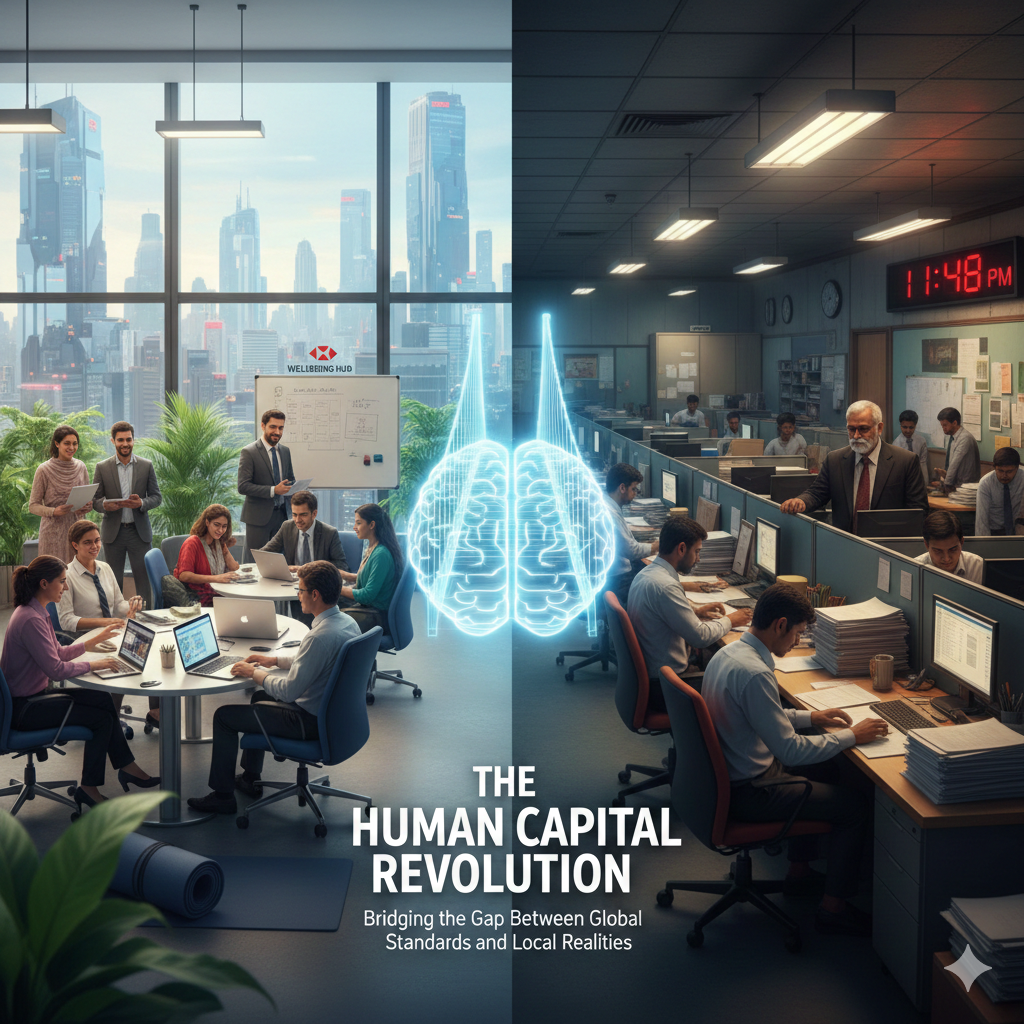
In the rapidly evolving landscape of global business, the definition of a “successful” organization has shifted. It is no longer measured solely by balance sheets, but by the vitality of its human capital. While global giants and international development banks have mastered the art of “psychological safety” and “holistic well-being,” many sectors in Bangladesh—particularly the private banking industry—are still grappling with a legacy of high-pressure, rigid hierarchies.
The Gold Standard: Global Cultures of Empathy
Organizations like HSBC, British American Tobacco (BAT), the World Bank, and the Asian Development Bank (ADB) do not view employee well-being as a luxury; they view it as a strategic imperative. Their cultures are built on several core pillars that distinguish them from traditional local models.
1. Psychological Safety and Mental Health
At HSBC, mental health is a formal policy. With over 80% of its global workforce rating their mental health as positive, the bank employs “Mental Health Allies” and provides access to telemedicine and virtual GPs. They foster an environment where employees are encouraged to “speak up” without fear of retribution—a concept known as psychological safety.
2. The “Whole Person” Approach
BAT (British American Tobacco) is frequently recognized as a “Top Employer” because it treats employees as individuals with lives outside the office. Their “Life at BAT” philosophy includes:
- Hybrid Flexibility: Autonomy to schedule work-from-home time.
- Family-First Policies: Robust parental leave and support systems that ensure no one has to choose between a career and a family.
3. Comprehensive Security
Development giants like the World Bank and ADB offer benefits that extend far beyond a paycheck. Their packages include generous annual leave (typically 26+ days), mortgage subsidies, and international relocation support. By removing “survival anxiety,” these organizations allow their staff to focus entirely on high-level innovation and problem-solving.
The Bangladesh Context: The Private Bank Pressure Cooker
In contrast, the private banking sector in Bangladesh—while a cornerstone of the national economy—often operates under a different set of unwritten rules. While international firms focus on “output,” many local private banks still prioritize “attendance” and “endurance.”
| Feature | Global Standard (HSBC, ADB, BAT) | Typical BD Private Bank Culture |
|---|---|---|
| Working Hours | Result-oriented; flexible & hybrid options. | Clock-watching; late-staying is often seen as “loyalty.” |
| Promotion Criteria | Performance-based; meritocratic & transparent. | Often seniority-based or influenced by “relationship management.” |
| Mental Health | Openly discussed; subsidized counseling. | Often stigmatized or ignored as “personal weakness.” |
| Communication | Flat hierarchies; “open-door” policies. | Rigidly top-down; limited autonomy for juniors. |
The Cost of a “Tough” Culture
Recent studies on the Bangladeshi private sector highlight a worrying trend: financial stress and burnout are eroding productivity. When employees are burdened with unrealistic targets, a lack of job security, and zero work-life balance, the result is “Quiet Quitting” or high turnover.
In many local banks, the “Target Culture” is so aggressive that it leaves little room for the professional development or “learning hubs” that are standard at places like HSBC University.
Why Culture Matters for the Bottom Line
A healthy work culture is not just “being nice.” It is a business strategy. Organizations with high employee engagement see 21% higher profitability.
- Retention: High-talent individuals in Bangladesh are increasingly gravitating toward MNCs or tech startups that offer the empathy and respect they find lacking in traditional banking.
- Innovation: An employee who is afraid of their boss will never suggest a new idea. Innovation requires the safety to fail—a core tenet of the World Bank’s internal culture.
- Brand Reputation: In the age of Glassdoor and social media, a “toxic” culture can cripple a bank’s ability to attract the next generation of leaders.
The Path Forward: A Call to Transformation
For Bangladesh’s private banks to compete on a global stage, a “reincarnation” of corporate culture is necessary. This begins with:
- Empathy-led Leadership: Moving from “Command and Control” to “Support and Empower.”
- Defined Work Hours: Recognizing that an exhausted employee is a liability, not an asset.
- Wellness Benefits: Implementing insurance, mental health support, and flexible leave.
The success of BAT or ADB proves that when you take care of the people, the people take care of the business. It is time for Bangladesh’s corporate giants to move beyond the “paycheck-only” mindset and build workplaces where people truly thrive.