
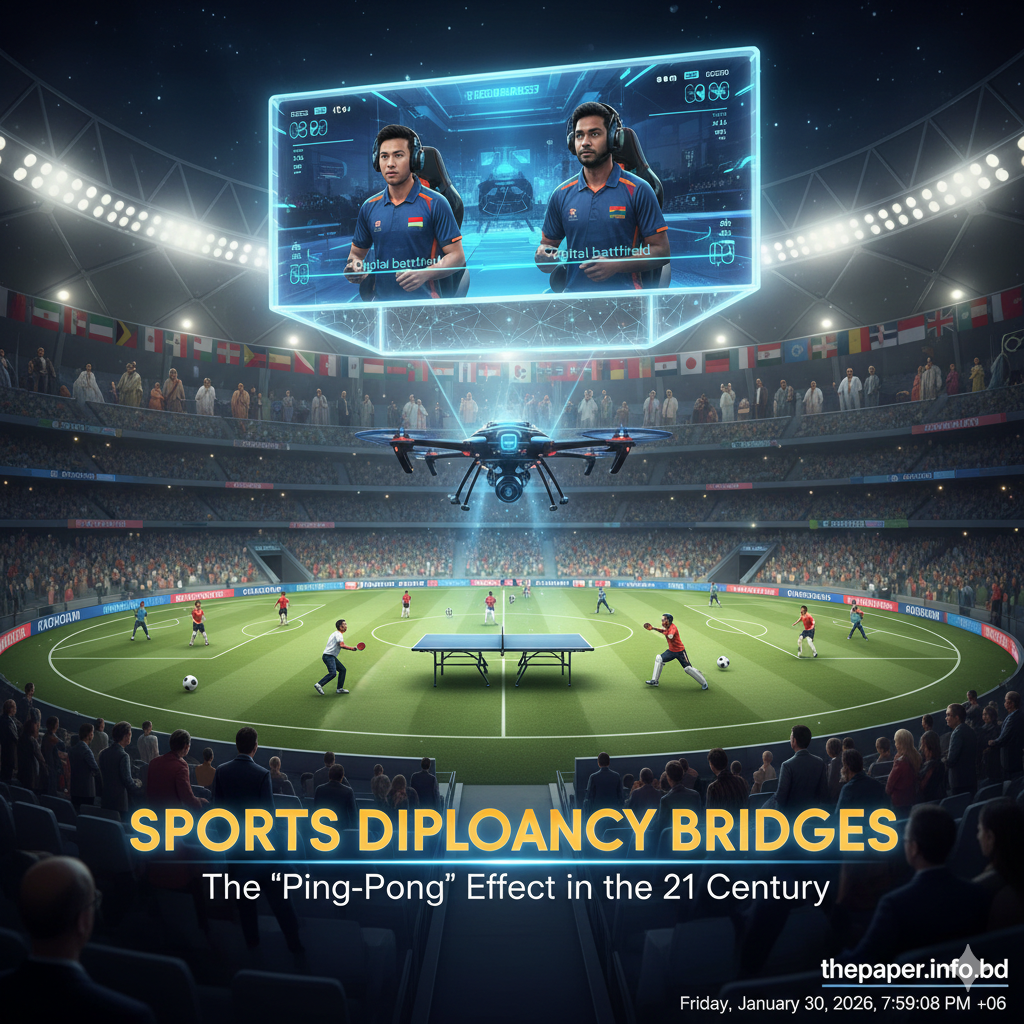
In the spring of 1971, a shaggy-haired American table tennis player named Glenn Cowan missed his team bus in Nagoya, Japan, and hopped onto the Chinese national team’s shuttle. That accidental encounter led to a gift—a silk-screened scarf—and a return gesture of a T-shirt. Within days, the U.S. team was invited to Beijing, thawing twenty years of icy silence between the two superpowers. This was “Ping-Pong Diplomacy,” a masterclass in how a simple game can achieve what high-level statecraft cannot.
As we navigate the fractured geopolitical landscape of 2026, the spirit of Nagoya has evolved. Sports diplomacy is no longer just a lucky accident or a symbolic handshake; it has become a sophisticated, multi-layered instrument of foreign policy. In an era of “hard” economic sanctions and military posturing, sports offer a “soft power” alternative—a way for nations to signal intent, build brand identity, and maintain back-channel communication when formal embassies go dark.
The New Architecture of Soft Power
In the 21st century, the “Ping-Pong Effect” has scaled up from local matches to “Mega-Event Diplomacy.” When a nation bids for the FIFA World Cup or the Olympics, it isn’t just seeking tourism revenue; it is auditioning for a seat at the table of global leadership.
For emerging powers, hosting these events is an act of “rebranding.” It allows a state to showcase infrastructure, modernization, and cultural openness to a global audience of billions. This is a double-edged sword, however. Critics often point to “sportswashing”—the use of sports to distract from internal political controversies or human rights records. Yet, from a purely diplomatic standpoint, the engagement is undeniable. By inviting the world into their stadiums, nations subject themselves to international scrutiny and, in turn, find themselves integrated more deeply into the global economic and social fabric.
The “Neutral Battlefield”: De-escalation Through Play
One of the most vital roles of sports in 2026 is providing a “neutral battlefield.” In traditional diplomacy, concessions are often viewed as weaknesses. In sports, however, the rules of the game provide a structured environment where rivals can meet without the immediate pressure of policy breakthroughs.
We see this in the ongoing “Cricket Diplomacy” between India and Pakistan. Even during periods of high border tension, a high-stakes cricket match serves as a pressure valve. It allows for “grandstand diplomacy,” where leaders can sit in the same VIP box, sharing a moment of athletic appreciation that signals to their respective populations—and the world—that the door to dialogue is not entirely bolted.
Similarly, the 2018 PyeongChang Winter Olympics demonstrated that sports could create a literal “common ground.” The joint march of North and South Korean athletes under a Unified Korea Flag was more than a photo op; it provided a temporary de-escalation that opened a window for subsequent high-level summits. It proved that while a hockey game cannot solve a nuclear crisis, it can create the psychological breathing room necessary for politicians to begin talking.
The Rise of Non-State Actors: Federations and Athletes
In the modern world order, the players of diplomacy aren’t just career diplomats in suits. They are the International Olympic Committee (IOC), FIFA, and the athletes themselves. These organizations often hold more “sovereignty” over global culture than individual states.
The power of these bodies was starkly visible following the geopolitical shifts of the early 2020s. The exclusion of certain national teams from global competitions became a form of “cultural sanction” that resonated more deeply with the average citizen than complex banking restrictions. When a nation is barred from the World Cup, the isolation is felt in every home and every street corner, exerting a unique brand of internal political pressure.
Furthermore, athletes have become independent diplomatic agents. In the age of social media, a global superstar like Cristiano Ronaldo or LeBron James carries more “cultural currency” than many foreign ministers. Their advocacy, their movements between leagues, and their personal interactions across borders create a “citizen diplomacy” that bypasses traditional government filters.
Economic Stakes and the Global Order
Sports diplomacy is inextricably linked to the global economy. The sale of broadcasting rights and the influx of foreign direct investment through sports ownership (such as sovereign wealth funds purchasing European football clubs) create interdependencies. When a nation owns a significant stake in another country’s cultural crown jewels—its sports teams—the cost of conflict rises. These “economic anchors” make it in everyone’s best interest to maintain a baseline of stability.
However, the 21st-century “Ping-Pong Effect” also faces new threats. The fragmentation of the world into competing “tech stacks” and political blocs threatens to polarize sports. We are seeing the rise of alternative “regional games” and parallel leagues that could, if left unchecked, mirror the “Scientific Sovereignty” seen in academic research—dividing the world rather than uniting it.
Conclusion: The Human Element
Ultimately, the power of sports diplomacy lies in its ability to humanize the “adversary.” It is difficult to maintain a caricature of a “hostile nation” when you are cheering for their striker’s skill or admiring their gymnast’s grace.
As we look toward the remainder of 2026 and beyond, the “Ping-Pong Effect” remains our most resilient tool for peace. It reminds us that beneath the layers of national interest, trade wars, and territorial disputes, there is a universal language of effort, merit, and fair play. In a world that often feels like it is pulling apart at the seams, the simple act of a ball crossing a net or a runner crossing a line remains a powerful stitch holding the global order together.