
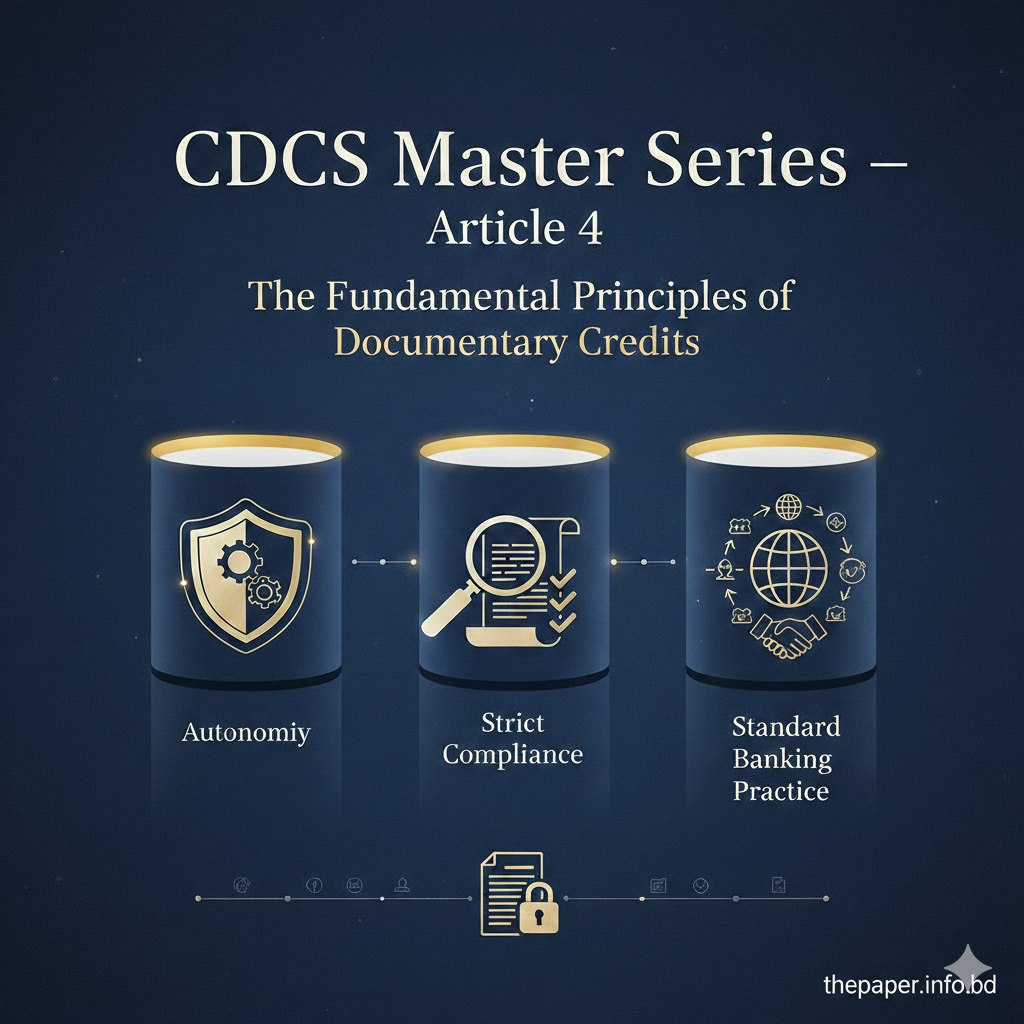
The Fundamental Principles of Documentary Credits: Autonomy, Strict Compliance & Standard Banking Practice
In international trade finance, rules matter. But principles matter more.
Behind every documentary credit lies a powerful legal structure built on three fundamental pillars:
- The Autonomy Principle
- The Principle of Strict Compliance
- Standard Banking Practice
These are not academic concepts. They are the living engine of trade finance. Every payment, every refusal, every court decision, and every CDCS examination question is rooted in these principles.
If a trade finance professional misunderstands them, mistakes follow. If they master them, clarity follows.
Why Principles Matter More Than Procedures
Many bankers focus on document checking techniques. But documentary credit operations are not mechanical processing tasks — they are governed by independent legal undertakings.
The global framework most widely applied is UCP 600 (Uniform Customs and Practice for Documentary Credits), published by the International Chamber of Commerce. UCP 600 does not operate alone; it rests firmly on the autonomy and strict compliance doctrines.
Without these principles, documentary credits would collapse into ordinary commercial disputes.
1️⃣ The Autonomy Principle (Independence Principle)
What It Means
The autonomy principle states that:
A documentary credit is independent of the underlying sales contract or other agreement.
This means:
- The issuing bank’s obligation to pay is separate from the sales contract.
- Disputes between buyer and seller do not affect the bank’s undertaking.
- Banks deal with documents, not goods.
This principle is explicitly reflected in UCP 600 Article 4.
Why Autonomy Exists
International trade involves distance, legal uncertainty, and country risk. Buyers and sellers often operate under different legal systems.
If banks were required to investigate:
- Quality disputes
- Delivery delays
- Contract breaches
— documentary credits would become impractical and unpredictable.
Autonomy ensures certainty.
Practical Example
A Bangladeshi importer claims that goods shipped from Europe are defective.
The exporter presents documents fully compliant with the LC.
Under the autonomy principle:
- The issuing bank must pay.
- The buyer must resolve quality disputes separately through legal channels.
The bank cannot withhold payment because of commercial dissatisfaction.
CDCS Exam Focus
Common trick question:
If goods are defective but documents comply, must the bank honour?
Correct answer: Yes.
Autonomy protects the documentary credit from commercial disputes.
2️⃣ The Principle of Strict Compliance
If autonomy protects independence, strict compliance protects discipline.
What Strict Compliance Means
Banks must determine whether documents:
Comply strictly with the terms and conditions of the credit.
Even minor discrepancies can justify refusal.
This does not mean documents must be identical in wording — but they must not conflict.
Why Strict Compliance Exists
Banks are not investigators. They rely entirely on paper.
If banks accepted approximate compliance:
- Risk would increase dramatically
- Fraud exposure would rise
- Payment certainty would decline
Strict compliance ensures precision and predictability.
Examples of Discrepancies
- Late shipment date
- Missing signature
- Inconsistent goods description
- Insurance coverage below required percentage
- Different port of discharge
Even small inconsistencies can lead to refusal.
But Is It “Absolute” Strictness?
Modern practice recognises that strict compliance does not require mirror-image wording.
For example:
- “Steel rods” vs “Hot rolled steel rods” may be acceptable if not inconsistent.
- Abbreviations may be acceptable if clear.
This balance is reflected in international banking practice.
CDCS Exam Insight
Candidates often fail by:
- Being too lenient
- Or being too rigid
The correct approach is:
Documents must not conflict with the credit, other documents, or international standard banking practice.
3️⃣ International Standard Banking Practice (ISBP)
Strict compliance is applied through standard banking practice, not personal interpretation.
The ICC publishes guidance known as International Standard Banking Practice (ISBP 745).
ISBP clarifies:
- How banks examine transport documents
- Insurance documents
- Commercial invoices
- Certificates of origin
- Drafts
Why ISBP Is Important
Without ISBP:
- Each bank would interpret compliance differently.
- Global uniformity would disappear.
ISBP promotes harmonised interpretation.
Example
An LC requires:
“Full set of clean on board ocean bills of lading.”
ISBP clarifies:
- What “clean” means
- What constitutes a “full set”
- How endorsements should appear
This reduces subjectivity.
Autonomy vs Fraud Exception
Autonomy is strong — but not absolute.
Courts in many jurisdictions recognise a limited exception:
Fraud.
If documents are clearly fraudulent, a court may intervene to stop payment.
However:
- Fraud must be proven clearly.
- Mere suspicion is not enough.
Banks do not decide fraud; courts do.
This area is frequently tested conceptually in CDCS exams.
The Interplay Between the Three Principles
Let us see how they work together:
| Principle | Protects | Purpose |
|---|---|---|
| Autonomy | Independence | Prevents commercial disputes affecting payment |
| Strict Compliance | Certainty | Ensures documentary precision |
| Standard Banking Practice | Uniformity | Harmonises interpretation globally |
Together, they create a predictable global system.
Real-World Case Scenario
An exporter presents documents under an LC requiring:
- Shipment by 30 June
- Insurance for 110% invoice value
- Bill of lading showing freight prepaid
Documents show:
- Shipment 29 June
- Insurance for 100%
- Freight prepaid
Result:
- Non-compliance due to insufficient insurance coverage.
- Bank entitled to refuse.
Even though shipment occurred on time and goods were shipped properly, strict compliance prevails.
Why These Principles Matter for Bangladesh
In emerging markets, documentary credits remain a dominant trade finance instrument.
Understanding autonomy and strict compliance protects:
- Exporters from unjustified expectations
- Importers from documentary risk
- Banks from operational mistakes
- Courts from confusion
Trade disputes often arise not from fraud — but from misunderstanding these principles.
CDCS Examination Perspective
Article 4 is foundational.
Expect questions such as:
- Can a bank investigate quality disputes?
- Must minor spelling differences cause refusal?
- What governs document examination?
- Does confirmation change autonomy?
If you understand the principles, answers become obvious.
Editorial Reflection: Beyond the Exam
Documentary credits have survived for more than a century because of legal certainty.
Autonomy protects independence.
Strict compliance protects discipline.
Standard practice protects uniformity.
Together, they create trust in cross-border trade.
In an era of digital trade, blockchain platforms, and electronic bills of lading, these principles remain unchanged. Technology evolves. Legal foundations endure.
For trade finance professionals, mastering these principles is not merely an academic requirement — it is professional maturity.