
A Letter of Credit is not a single instrument but a toolkit. Each type—sight, usance, transferable, back-to-back, revolving, or standby—serves a distinct commercial purpose. For prospective CDCS professionals, mastering these structures is essential not only for passing the exam but for structuring safe, efficient international transactions.
Why Documentary Credit Types Matter
In theory, a documentary credit is simply a bank’s undertaking to honour compliant documents. In practice, the structure of that undertaking determines:
- When payment happens
- Who receives payment
- How suppliers are financed
- How risk is distributed
- How complex document examination becomes
Understanding LC types therefore moves a practitioner from document processor to trade finance strategist.
1. Sight Letter of Credit — The Immediate Payment Instrument
Definition
A Sight LC is payable immediately once compliant documents are presented and accepted by the nominated or issuing bank.
Operational Flow
- Exporter ships goods
- Presents documents
- Bank checks compliance
- Payment released promptly
Commercial Purpose
- Provides fast liquidity to exporters
- Ensures payment only after shipment evidence
- Reduces financing uncertainty
Typical Use
- Garment exports
- Commodity trading
- New buyer-seller relationships
Risk Perspective
| Party | Benefit | Risk |
|---|---|---|
| Exporter | Quick payment | Must prepare accurate documents |
| Importer | Shipment confirmed | Cash outflow immediate |
| Bank | Simple structure | Standard documentary risk |
CDCS Reminder
If LC states “available by payment at sight”, it is a sight credit — no deferred obligation exists.
2. Usance (Deferred Payment) Letter of Credit — Built-In Trade Credit
Definition
A Usance LC promises payment at a specified future date after shipment or presentation.
Examples
- 60 days after bill of lading date
- 90 days after sight
- 120 days from invoice date
Commercial Logic
Buyers gain time to:
- Sell goods
- Generate revenue
- Manage working capital
Exporters still benefit from the bank’s undertaking.
Financing Option
Exporter may:
- Wait until maturity
OR - Discount the LC with a bank for early funds
Key Exam Insight
Deferred payment does not reduce issuing bank obligation.
Payment timing changes — legal certainty does not.
3. Transferable Letter of Credit — Supporting Intermediary Trade
Definition
A Transferable LC allows the first beneficiary to transfer rights to a second beneficiary.
Typical Scenario
Buyer → Trader → Manufacturer
The trader:
- Receives LC from buyer
- Transfers LC to manufacturer
- Keeps margin between purchase and resale price
Important Rules
- LC must explicitly state “transferable”
- Usually transferable only once
- Amount and price can be reduced
- Shipment date cannot be extended
Operational Advantage
Allows traders to:
- Conduct international trade
- Without full upfront capital
CDCS Trap
If LC is silent on transferability → it is NOT transferable.
4. Back-to-Back Letter of Credit — When Transfer Is Not Allowed
Definition
A Back-to-Back LC is a second LC issued using the original LC as collateral.
Structure
- Buyer issues LC to trader
- Trader requests bank to issue second LC to supplier
- Supplier ships goods
- Documents pass through trader
Why Not Use Transferable LC Instead?
Because:
- Original LC may prohibit transfer
- Trader wants to hide buyer identity or pricing
- Bank wants tighter control over documentation
Operational Risks
- Two sets of documents must match
- Shipment timing must align
- Financing exposure increases
Professional Insight
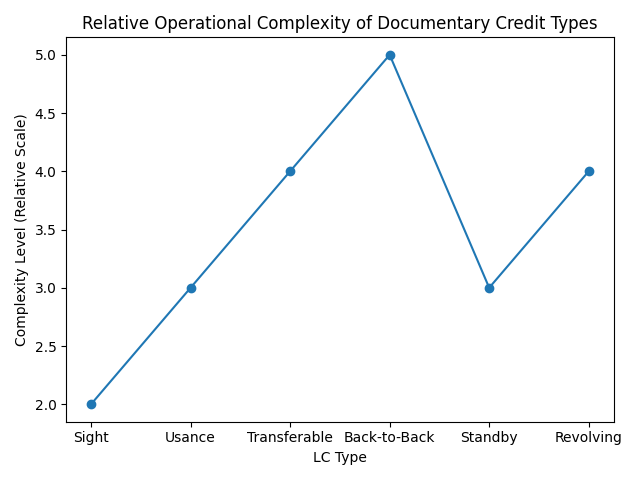
Back-to-back credits are common but complex, especially in export-manufacturing economies.
5. Revolving Letter of Credit — Designed for Continuous Trade
Definition
A Revolving LC automatically reinstates its value after use.
Example
Importer needs:
- $50,000 shipment every month
Instead of issuing 12 LCs:
- One LC automatically renews monthly
Forms
- Time revolving: resets each period
- Value revolving: reinstates after utilisation
Advantages
- Reduces paperwork
- Speeds up repeat shipments
- Supports stable trade partnerships
Exam Tip
Revolving credits are about repeated availability, not higher total value.
6. Standby Letter of Credit — The Guarantee Mechanism
Definition
A Standby LC pays only if the applicant fails to perform contractual obligations.
Function
Acts as:
- Performance guarantee
- Loan security
- Bid bond substitute
- Contract assurance
Example
If contractor fails to complete work:
- Beneficiary submits claim
- Bank must pay if documents comply
Conceptual Difference
| Commercial LC | Standby LC |
|---|---|
| Expected to be used | Expected NOT to be used |
| Supports payment | Supports performance security |
CDCS Insight
Standby credits operate under documentary credit rules but behave commercially like guarantees.
How to Identify LC Types in CDCS Questions
Look for keywords:
- “At sight” → Sight LC
- “90 days after BL date” → Usance LC
- “This credit is transferable” → Transferable LC
- “Second LC issued based on first” → Back-to-Back
- “Automatically reinstated” → Revolving LC
- “Payable upon default claim” → Standby LC
Exams test recognition in context, not memorised definitions.
Why Mastering LC Types Matters in Real Banking
Trade finance professionals frequently encounter situations where:
- Exporter needs early liquidity
- Importer requires deferred payment
- Trader lacks production capacity
- Supplier chain involves multiple tiers
- Long-term supply requires efficiency
- Contract performance needs guarantee
Choosing the wrong LC type can:
- Delay shipment
- Increase financing cost
- Create documentary mismatch
- Expose banks to unnecessary risk
Understanding LC types transforms technical knowledge into commercial judgment.
Final Reflection
The Letter of Credit survives because it adapts.
It can be a payment tool, a financing method, a supply-chain enabler, or a contractual safety net. Each variation reflects a different commercial need, yet all remain anchored in the same documentary principles.
For prospective CDCS professionals, learning LC types is not about memorising categories. It is about understanding how global trade actually functions — through structured promises, controlled risks, and carefully designed financial instruments.