
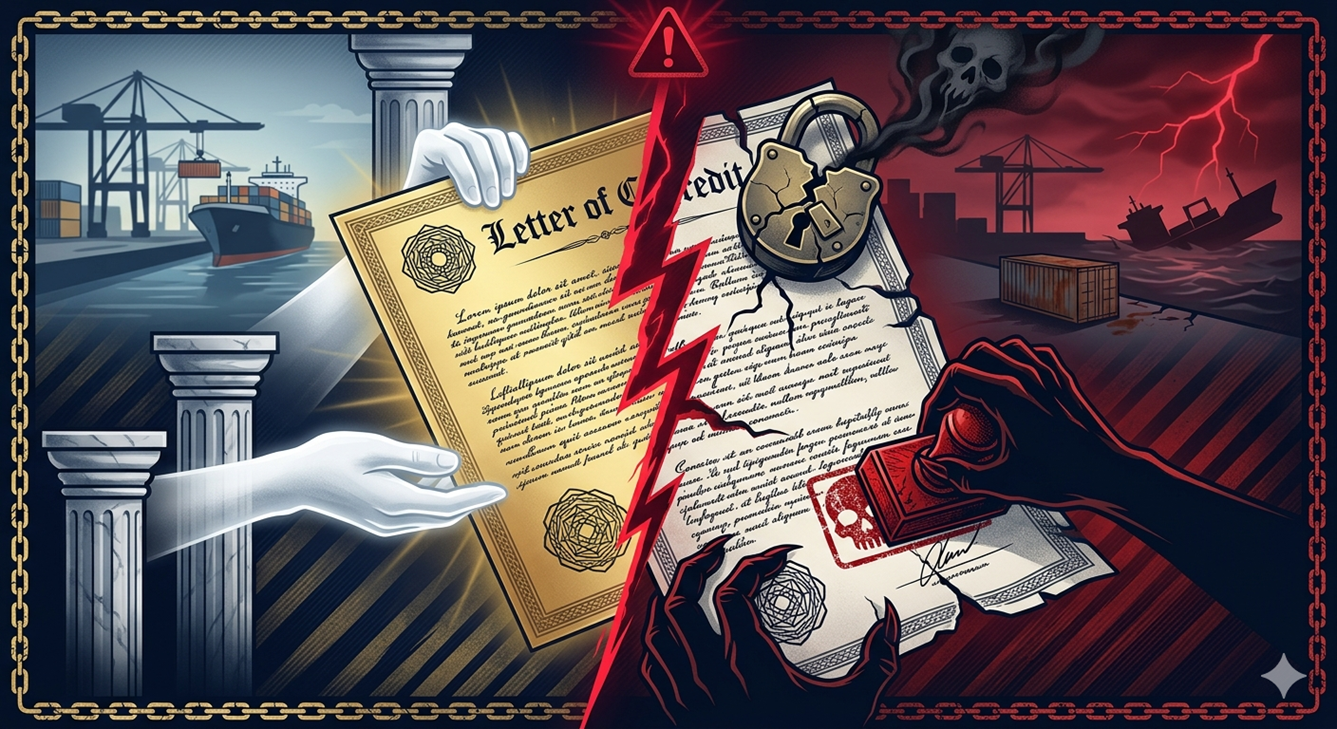
Fraud, Forgery
and Failure
When Trust Breaks in Documentary Credits — the darker side of the system that underpins global trade.
A shipment is declared loaded. Documents appear complete. Payment is released.
Days later, the buyer discovers the goods never existed.
In another case, a bank refuses documents citing discrepancies — only to face legal action from the beneficiary. Elsewhere, forged bills of lading circulate through the system, backed by seemingly legitimate paperwork.
These are not theoretical risks. They are real events that have shaped the evolution of trade finance.
In this article, we explore the darker side of documentary credits: fraud, disputes, and the limits of the system that underpins global trade.
The Foundation: Trust Built on Documents
The documentary credit system rests on a critical assumption — one that both enables global commerce and exposes it to a fundamental vulnerability.
Banks deal in documents, not goods.
This principle, codified in UCP 600 Article 5, allows the system to function at global scale. Banks cannot inspect shipments. They cannot verify cargoes. Their obligation is strictly documentary. A complying presentation triggers payment — regardless of what is actually on the ship.
The efficiency this creates is enormous. But so is the vulnerability. If documents are falsified — and appear compliant on their face — the system can be exploited. And it has been, repeatedly.
Types of Fraud in Documentary Credits
Fraud in trade finance is not monolithic. It takes several distinct forms, each exploiting a different weakness in the documentary chain.
Forged Documents
The most prevalent form. Fraudulent actors create convincing copies of legitimate trade documents.
- Fake bills of lading
- Forged inspection certificates
- Fabricated insurance documents
Non-Existent Goods
Documents appear genuine, but the underlying transaction is entirely fictitious. No goods are shipped — or even exist.
- Phantom shipments
- False vessel bookings
- Fabricated warehouse receipts
Collusion Fraud
Multiple parties collaborate to engineer a fraudulent transaction. Particularly difficult to detect because documents appear internally consistent.
- Exporter + shipping agent collusion
- Buyer participation in financing fraud
- Intermediary invoice manipulation
Invoice Manipulation
Systematic distortion of transaction values to achieve financial or regulatory objectives.
- Over-invoicing for higher financing
- Under-invoicing to evade duties
- Split invoicing schemes
Each type exploits the same core principle: that banks verify documents, not reality. A sophisticated forgery — one that is not apparent on the face of the document — places the bank in an almost impossible position. Under UCP 600, their obligation is to examine what is presented, not to investigate what occurred.
The Fraud Exception: A Critical Legal Concept
Although banks are bound to honour complying presentations, there is a narrow but legally significant exception. It is known simply as the fraud exception.
The Fraud Exception — Key Threshold
A bank may refuse to honour a credit — even against a complying presentation — if fraud is clearly established before payment. However, the bar is deliberately high.
- The fraud must be material — not a minor irregularity
- The evidence must be clear and not merely alleged
- The bank must assess legal risks of wrongful refusal
- Court injunctions are typically required in practice
Wrongful refusal — refusing a legitimate presentation on suspicion alone — exposes the bank to serious legal liability. This is why fraud cases remain among the most complex decisions in trade finance.
The fraud exception is not a licence for banks to second-guess presentations. It is an emergency brake — available only in the clearest cases. In practice, banks that suspect fraud typically seek a court injunction rather than acting unilaterally.
Disputes in Documentary Credits
Not every problem in documentary credits involves fraud. Many of the most common and costly disputes arise from something far more mundane: disagreements over document examination.
An exporter presents documents under a letter of credit. The issuing bank refuses, citing a discrepancy in the goods description. The exporter argues the differences are minor and acceptable under international banking practice.
Who is right?
The answer depends on multiple factors that CDCS professionals must be able to evaluate:
- The exact wording and conditions of the credit
- The nature and materiality of the alleged discrepancy
- The applicable provisions of UCP 600 and ISBP 745
- Whether refusal was communicated correctly and within time
These disputes often hinge on interpretation. ISBP 745 — the International Standard Banking Practice — exists precisely to reduce ambiguity in document examination. Yet disputes persist, because trade documents are generated by human beings under commercial pressure, and language is never perfectly precise.
“Fraud and disputes do not undermine the documentary credit system. They define its boundaries.”
CDCS Master Series — Article 15The Risk for Banks
Fraud and disputes create multiple categories of exposure for financial institutions. Understanding these risks is essential for anyone working in trade finance operations, compliance, or relationship management.
Financial Risk
If a bank honours a fraudulent presentation, recovery from the applicant or overseas parties may be difficult, lengthy, or impossible.
Legal Risk
Both wrongful dishonour and wrongful honour of a credit can result in litigation, damages, and regulatory scrutiny.
Reputational Risk
Repeated disputes or high-profile fraud involvement damages a bank’s credibility in correspondent banking and international markets.
Banks manage these risks through a combination of experienced document examiners, robust internal controls, active compliance frameworks, and — increasingly — technology-driven detection systems.
Why Fraud Still Exists
Despite decades of rule refinement, professional training, and institutional investment, fraud in trade finance persists. The reasons are structural.
Global supply chains involve dozens of parties across multiple jurisdictions. No single authority has visibility over the entire transaction. Legal standards vary dramatically between markets. Pressure to process transactions quickly creates windows of opportunity. And the growing sophistication of fraudulent actors — including state-sponsored operators in some cases — means that old detection methods are constantly being outpaced.
The documentary credit system reduces risk. It does not eliminate it. That distinction matters enormously for practitioners.
The Role of Technology
Technology is increasingly deployed to close the gap between documentary compliance and underlying reality.
These tools improve transparency significantly. But they also introduce new attack surfaces: cyber fraud, data manipulation, and the risk that digital systems create false confidence. Technology is an aid to human judgment — not a replacement for it.
Lessons for Trade Finance Professionals
-
Understand the Limits of Documentary Examination Banks verify documents — not reality. This is not a weakness in the system. It is a deliberate and necessary design choice that makes global trade possible. But practitioners must never forget it.
-
Apply Professional Scepticism Even a technically compliant presentation can conceal fraud. Experienced examiners develop instincts. They notice inconsistencies. They ask questions. Compliance with rules is a floor, not a ceiling.
-
Follow Refusal Procedures Precisely Under UCP 600, refusal must be communicated on time, correctly, and with all discrepancies listed at once. Procedural errors in refusing a presentation can forfeit the right to refuse entirely.
-
Stay Continuously Updated Fraud methods evolve faster than rules do. ICC guidance, bank circulars, and CDCS continuing education exist precisely to keep practitioners current. Complacency is a vulnerability.
CDCS Examination Perspective
Fraud and dispute scenarios occupy a significant portion of the CDCS examination. These are not knowledge questions. They are judgment questions — and they test whether candidates can reason through ambiguity under pressure.
What CDCS Candidates Must Demonstrate
- Accurate application of UCP 600 Articles — particularly Articles 2, 5, 7, 14, 15, and 16
- Fluency with ISBP 745 principles for document examination and interpretation
- The ability to evaluate bank obligations when fraud is alleged — not proven
- Understanding of the fraud exception threshold and the legal implications of wrongful dishonour
- Distinction between document discrepancies, genuine fraud, and commercial disputes
Examiners consistently reward candidates who demonstrate nuanced thinking — who can identify not just the rule, but its limits, and who can articulate why a particular situation is genuinely difficult.
Trust, Tested
In international trade, trust is never absolute. It is supported by documents, reinforced by banks, and governed by rules. But it is also tested — by human error, by commercial pressure, and sometimes by deliberate deception.
Fraud and disputes reveal the limits of any system built on documentation. They remind us that while rules can structure transactions, they cannot fully replace the judgement of the people who operate within them.
For CDCS professionals, understanding these boundaries is not an academic exercise. In the real world of trade finance, the challenge is not only to follow the rules — but to recognise when the rules themselves are being tested.
References: ICC Uniform Customs and Practice for Documentary Credits (UCP 600); International Standard Banking Practice (ISBP 745); ICC Banking Commission Opinions; Bhogal & Trivedi, International Trade Finance; Byrne, The Comparison of UCP600 & eUCP. This article is educational in nature and does not constitute legal or financial advice.