
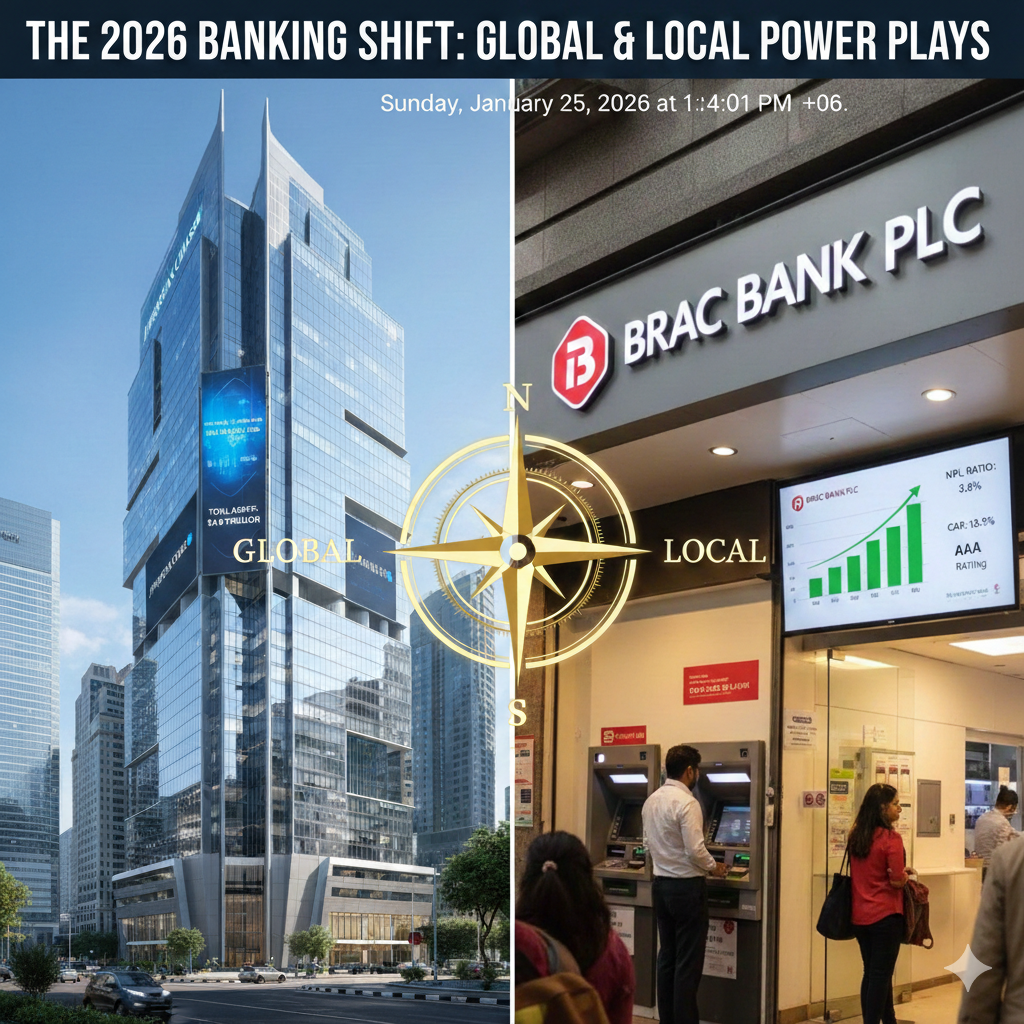
In the early weeks of 2026, the global banking industry is defined by two distinct narratives: a steady, digital-first growth among global powerhouses and a period of radical “re-cleansing” within local markets like Bangladesh. For depositors and investors, the “overall position” of a bank is no longer merely a reflection of its physical branches, but a complex calculation of Asset Quality, Governance, and Shareholder Rewards.
This article integrates the latest audited 2024/25 data with the most recent January 2026 unaudited snapshots to present a comprehensive guide to the banking landscape.
1. Global Titans: The Battle of Scale vs. Value
Globally, the industry remains a duopoly between the sheer asset size of Chinese state-owned banks and the market efficiency of American financial giants. As of January 2026, the rankings showcase a widening gap between “books” and “value.”
Top 5 Global Banks by Total Assets (Reference: 2025/26 Audited Estimates)
| Rank | Institution | Headquarters | Total Assets (USD Trillion) |
|---|---|---|---|
| 1 | ICBC | China | $6.69 |
| 2 | Agricultural Bank of China | China | $5.92 |
| 3 | China Construction Bank | China | $5.56 |
| 4 | Bank of China | China | $4.80 |
| 5 | JPMorgan Chase | USA | $4.00 |
The Valuation Paradox: While ICBC leads in assets, JPMorgan Chase remains the world’s most valuable bank by market capitalization, valued at approximately $810.5 billion as of late January 2026. This reflects investor confidence in Western “capital-light” models—focusing on fees and wealth management—compared to the credit-heavy models in Asia.
2. The Local Perspective: Bangladesh’s “Flight to Quality”
The Bangladeshi banking sector has reached a critical juncture. Following the enactment of the Bank Resolution Ordinance 2025, the “wheat is being separated from the chaff.” While some state-owned and Shariah-based banks have been consolidated due to systemic risks, a select group of Private Commercial Banks (PCBs) is thriving.
Ranking the Local Champions (2025-2026 Performance Indicators)
Based on the latest Bonik Barta Top Banks 2024/25 and January 2026 unaudited disclosures:
- BRAC Bank PLC (#1 Overall): BRAC has secured the top spot by ranking first in four critical categories: NPL (Non-Performing Loans), Capital Adequacy Ratio (CAR), Net Profit, and Operating Profit per Branch. It is the only bank in the country with an AAA credit rating from CRAB and a stable outlook from international agencies like S&P.
- City Bank PLC (#2 Overall): A leader in digital innovation, City Bank holds a dominant position in the “Credit Card and Retail” segment. Its integration with fintech subsidiaries (like bKash) has fueled a 20% growth in its digital deposit base.
- Prime Bank (#3 Overall): Prime Bank ranks second in both ROE (Return on Equity) and CAR, signaling high efficiency and a strong buffer against potential loan defaults.
- Eastern Bank PLC (EBL): EBL remains the most efficient bank in terms of Operating Profit and maintains one of the lowest NPL ratios in the country (approx. 3.34%).
- Pubali Bank: Representing the first-generation banks, Pubali has seen a resurgence, ranking 3rd in total Net Profit due to its massive rural network and stable deposit base.
3. Rewards and Dividends: The Shareholder Experience
In 2026, the “reward” a bank provides is a primary indicator of its health.
- Global Dividends: Total global banking dividends reached a record $1.14 trillion in late 2025. HSBC and JPMorgan have led the way, with HSBC outperforming many peers with a 59% stock return over the last 12 months, driven by its pivot toward high-growth Asian emerging markets.
- Local Yields: In Bangladesh, the “A-List” (BRAC, City, EBL) have consistently rewarded shareholders with a mix of cash and stock dividends ranging from 12.5% to 20%, a stark contrast to the troubled sector where dividends have been suspended by the regulator.
4. Technical Performance: Audited Truth vs. Unaudited Risk
The most pressing concern for the local market is the Non-Performing Loan (NPL) crisis. According to the ICCB News Bulletin (Jan 2026), the total volume of NPLs in Bangladesh has reached an alarming Tk 6.44 lakh crore, or 35.7% of all outstanding loans.
Sector Health Snapshot (January 2026)
| Metric | Global Top Tier (Avg) | Bangladesh Top 5 (Avg) | Bangladesh Sector (Overall) |
|---|---|---|---|
| NPL Ratio | 1.5% | 3.8% | 35.7% |
| CAR (Capital) | 14.5% | 13.5% | < 5.0% |
| Return on Equity | 12.0% | 16.8% | Negative |
The 2026 Outlook: The data reveals a “two-speed” banking system. While the top 5-10 private banks are performing at international standards, the rest of the sector is undergoing a painful but necessary correction.
Conclusion: Navigating Your Finances in 2026
The 2026 banking article paints a clear picture: Scale is good, but Governance is better. Whether you are looking at the global $6 trillion books of ICBC or the AAA-rated resilience of BRAC Bank, the lesson remains the same. The “position” of a bank is defined by its transparency. For the average reader, moving deposits to institutions with low NPLs and high CAR ratios is no longer a suggestion—it is a necessity for financial survival.