
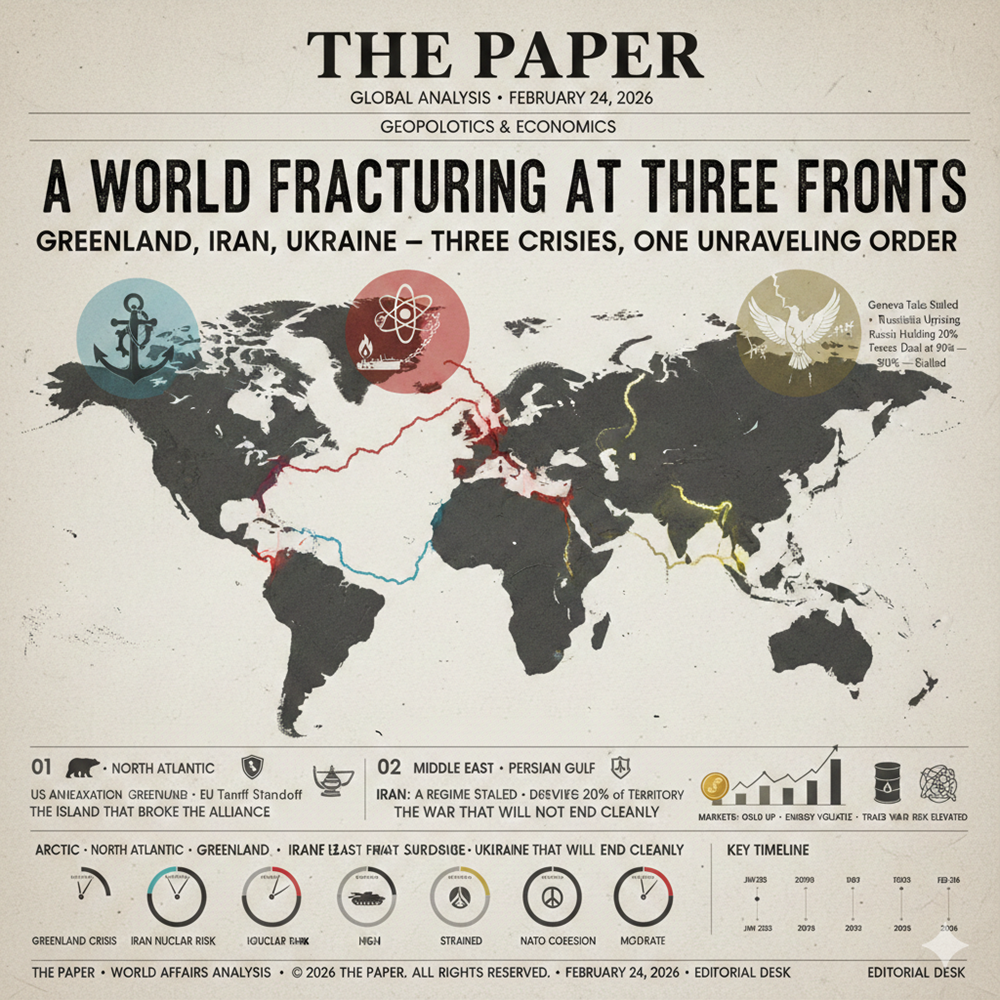
A World Fracturing
at Three Fronts
Greenland, Iran, Ukraine — three crises, one unravelling order. What the collisions of 2025–26 mean for the global economy, and what a clear mind should do now.
The world has entered a period its historians will struggle to name. Not yet a world war, not quite peace — something more disorienting: an era of simultaneous, interconnected crises that feed on each other’s momentum. In the opening weeks of 2026, three fault lines are cracking at once. The Arctic is being claimed. The Persian Gulf is being contested. And somewhere between Kyiv and Moscow, the outlines of an unequal armistice are being sketched. What happens at each of these flashpoints does not stay there. They are joined by energy, capital, alliance systems, and the brittle psychology of great powers that have run out of patience.
This is not the familiar geopolitics of the Cold War, where two superpowers maintained a terrifying but stable equilibrium. This is something messier: a multipolar scramble where a transactional United States, a revanchist Russia, an opportunistic China, and a fragmented Europe are all simultaneously rewriting the rules. The investor, the policymaker, and the citizen watching the news from a distance all need the same thing — a clear account of what is actually happening, and what it rationally demands.
Greenland: The Island That Broke the Alliance
The United States’ pursuit of Greenland — an autonomous territory of Denmark and a founding NATO member — has forced an unprecedented rupture in the transatlantic alliance. President Trump refused to rule out the use of military force to annex Greenland and threatened a 25% import tax on EU goods unless Denmark ceded the island. It was a demand that no Western leader had heard from Washington since the alliance was founded. On January 21, Trump reversed his most extreme position at Davos, pledging not to use force or tariffs — but the underlying ambition has not been withdrawn.
Why does Greenland matter so disproportionately? The answer runs through three separate logics that have converged simultaneously. First, the military logic: Greenland sits astride the GIUK Gap — the naval chokepoint between Greenland, Iceland, and the UK linking the Arctic to the Atlantic — and hosts the Pituffik Space Base, pivotal to monitoring Russian submarines and feeding early-warning systems for US homeland defence. Second, the resource logic: Greenland ranks eighth in the world for rare earth reserves, at 1.5 million tons, and holds two of the largest rare earth deposits on Earth — at a moment when China’s near-monopoly on these materials has already disrupted Western automotive supply chains. Third, the climate logic: as Arctic ice retreats, two new shipping routes — the Northwest Passage and the Transpolar Sea Route — are becoming commercially viable, adding maritime and economic value that is only growing.
“Greenland is not a real estate transaction. It is where the Arctic, the Atlantic alliance, the energy transition, and the logic of empire converge at once.”
— The Paper Editorial AnalysisGreenlanders have responded with large demonstrations, carrying placards reading “we are not for sale” and “Yankee go home.” Their defiance is backed by law: Greenland has had self-governing status since 1979 and the legal right to declare independence from Denmark. Most Greenlanders support eventual independence, though economic reliance on Danish subsidies complicates this. The paradox is that US pressure may accelerate independence rather than annexation — a scenario Washington has not fully modelled.
For Europe, the crisis has exposed a strategic complacency that stretches back decades. In June 2025, the Trump administration shifted Greenland from US European Command to Northern Command — a bureaucratic move signalling Washington’s growing view of the Arctic as a US hemisphere concern, not a shared NATO one. The most probable outcome, analysts believe, is one that nominally preserves Danish sovereignty but cedes significant economic and military authority to the United States. That is not a resolution. It is a redefinition — of sovereignty, of alliance, and of what the word “ally” now means in Washington.
Supply chain exposure: Chinese export controls on heavy rare earth elements in 2025 exposed Western automotive supply chains to production pauses and delays. Greenland’s deposits represent one of the few large-scale alternatives outside Chinese jurisdiction.
Tariff risk: Eight European countries faced a potential 10% additional tariff rising to 25% by June 2026 unless Denmark agreed to a sale. Markets wobbled, with equities slipping and gold edging higher.
Iran: A Regime That Survived, and Became More Dangerous
If Greenland represents a crisis of alliance, Iran represents a crisis of deterrence — and its collapse. The twelve-day war of June 2025, in which Israel struck Iran’s nuclear facilities and the United States followed with strikes on Fordow, Natanz, and Isfahan, was supposed to resolve the Iranian nuclear question by force. It did not. Iran’s theocracy exits 2025 battered yet still standing, and analysts warn Tehran is interpreting survival as grounds for taking greater risks in 2026. The regime’s internal logic is darkly consistent: what did not destroy it made it bolder.
In 2025, the US and Israel struck Iran’s nuclear programme, the UN reimposed sanctions, and Iran’s economy continued to struggle. Iran’s regional position worsened — established leaders of Iran-backed groups were eliminated and their strength weakened. Yet the theocracy did not fall. The conflict delivered a sudden shock to a system already weakened by years of sanctions, mismanagement, and infrastructural decay, displacing nearly seven million people from urban centres during the war.
“The strikes were meant to end Iran’s nuclear ambitions. Instead they may have concentrated them. A regime that survived now believes it can survive anything.”
— The Paper Editorial AnalysisThe nuclear picture remains acutely dangerous. Tehran has adopted a nuclear posture focused on survival, with several intelligence agencies suggesting Iran has increased enrichment toward 90% — weapons-grade — as an ultimate deterrent against regime change. Meanwhile, on February 3, 2026, six IRGC Navy gunboats attempted to seize a US tanker in the Strait of Hormuz, and on February 5, Iran’s IRGC Navy seized two foreign oil tankers near Farsi Island. During nuclear talks in Geneva, Khamenei threatened US warships in the area, and the Strait of Hormuz was closed for several hours during a live military fire drill.
The Strait of Hormuz is not a peripheral concern. Approximately 20% of the world’s oil supply transits through it daily. Any sustained closure — or even a credible threat of one — would send energy prices to levels not seen since the 1970s oil shocks, triggering inflation across every import-dependent economy on earth. The scenario is not hypothetical. It is being rehearsed.
Beginning on December 28, 2025, protests spurred by Iran’s deteriorating economy and rising inflation spread to all 31 of Iran’s provinces. The 2025–26 protests differ fundamentally from earlier waves — they are broader, more persistent, and more explicitly aimed at dismantling the political foundations of the Islamic Republic. Yet the coercive apparatus remains intact. The regime has survived every protest wave since 1979. The question is not whether it will survive this one, but what shape it takes afterward — and whether that shape is more or less willing to negotiate.
Hormuz closure scenario: A sustained blockade would remove roughly 20 million barrels per day from global supply — one-fifth of world consumption — triggering oil price spikes, inflation surges, and recessionary pressure across import-dependent economies.
Sanctions drag: Despite sanctions, China has continued to purchase most of Iran’s oil exports, effectively insulating Tehran from full economic isolation while fracturing the international sanctions coalition.
Talks status: Indirect US-Iran talks were held in Muscat on February 6, with both sides describing the nuclear-focused discussions as a “good start” and agreeing to continue despite deep mistrust.
Ukraine: The War That Will Not End Cleanly
Ukraine enters its fourth year of full-scale war with its territory diminished, its infrastructure shattered, and its people exhausted — but its sovereignty intact and its army still fighting. Russia has seized approximately 20% of Ukrainian territory, including Crimea and parts of the Donbas, with Ukraine’s available generating electricity capacity fallen from 33.7 GW at the start of the invasion to about 14 GW as of January 2026. The blackouts are not incidental — they are strategic. Russia has systematically dismantled Ukraine’s capacity to survive winter, to power industry, to maintain normal civilian life.
And yet, peace — or something resembling it — is being negotiated. After talks with President Trump at the end of December 2025, President Zelenskyy said that 90% of a potential peace deal had been agreed. That remaining 10% is the hardest: territory, sovereignty, and security guarantees — the issues on which Russia and Ukraine are structurally unable to agree without one side absorbing enormous humiliation. Russia is demanding that Ukrainian forces withdraw from the Donbas as a precondition for any agreement, including parts of Ukraine’s Donetsk and Luhansk regions which Russia never controlled and still cannot occupy despite 12 years of attempts. Kyiv has repeatedly rejected this.
“Russia is not negotiating for peace. It is negotiating for time — to rearm, regroup, and return. The question is whether the West understands this before the deal is signed.”
— Clifford D. May, Foundation for Defense of DemocraciesThe Geneva talks of February 17–18, 2026 — the first US-mediated trilateral negotiations — ended after just two hours with no breakthrough. Zelenskyy confirmed that on the military track there was “progress”, but on the political track “the positions differ” and talks “were not easy.” Ukraine’s president accused Russia of “trying to drag out negotiations that could already have reached the final stage.” Russia’s delegation was led by Vladimir Medinsky, a hardliner who reportedly warned during earlier talks that Russia was prepared for a prolonged war if Kyiv rejected Moscow’s demands.
Europe has moved, remarkably, from observer to participant. A coalition of 35 countries — the “coalition of the willing” — gathered in Paris in January 2026, with France and the UK pledging to establish military hubs across Ukraine in the event of a ceasefire. US envoys Steve Witkoff and Jared Kushner attended for the first time, with Witkoff saying Trump “strongly stands behind security protocols” — marking a significant alignment between the US and European positions.
The economic consequences of Ukraine’s war continue to radiate far beyond its borders. European energy markets remain structurally disrupted. Grain supply chains — Ukraine and Russia together once supplied roughly 30% of global wheat exports — remain unpredictable. Defence spending across NATO has surged to levels not seen since the Cold War. And the longer the war continues, the more deeply it restructures global trade, energy flows, and the architecture of European security for a generation.
What Clarity Demands in an Age of Cascading Crises
Distinguish Signal from Noise
Not every provocation is a precursor to war. Trump’s Greenland rhetoric, at its peak, suggested military annexation of a NATO ally — an act that would have dissolved the alliance instantly. He reversed course at Davos. The pattern is escalation followed by partial retreat, repeated. The signal is the underlying ambition; the noise is the daily temperature. A clear mind tracks the former, not the latter.
Understand the Energy Vulnerability
Iran’s control over the Strait of Hormuz is not a theoretical risk — it is being actively rehearsed. Any individual or institution exposed to energy-intensive industries, import-dependent supply chains, or emerging market assets denominated in inflation-sensitive currencies needs to account for an oil shock scenario. This is not prediction; it is scenario literacy.
Read the Ukraine Peace Process Critically
A ceasefire is not the same as peace. Multiple analysts and Ukraine’s own president have noted that Russia appears to be using negotiations to buy time and regroup. A deal that freezes the front lines without credible security guarantees for Ukraine may simply defer the next phase of conflict by five to ten years — at the cost of the precedent that territorial conquest by force can go unreversed.
Watch China’s Positioning, Not Just Its Statements
China is the common thread running through all three crises. It opposes Greenland’s annexation. It continues buying Iranian oil, insulating Tehran from sanctions. It has refused to condemn Russia’s invasion of Ukraine. Beijing is not a neutral observer; it is a strategic beneficiary of Western distraction and alliance friction. Its actions — not its statements — reveal the architecture of a new order it is patiently constructing.
Resist the Comfort of False Resolution
All three crises have produced moments that felt like turning points — Davos, the Paris coalition summit, the Geneva talks. None of them resolved the underlying tensions. The logical error is confusing de-escalation with resolution. Greenland’s strategic contest will continue regardless of diplomatic language. Iran’s nuclear programme will rebuild. Russia’s territorial ambitions remain unchanged. The appropriate posture is sustained vigilance, not relief.
Recognise the Interdependence
These three crises are not separate. US focus on Greenland and Iran creates distraction from Ukraine. Europe’s dependence on US security guarantees limits its leverage in the Greenland dispute. Iran reads European preoccupation with Ukraine as reduced bandwidth for enforcement. The crises amplify each other. Any strategy — personal, institutional, or national — that addresses one in isolation from the others is working from an incomplete map.