
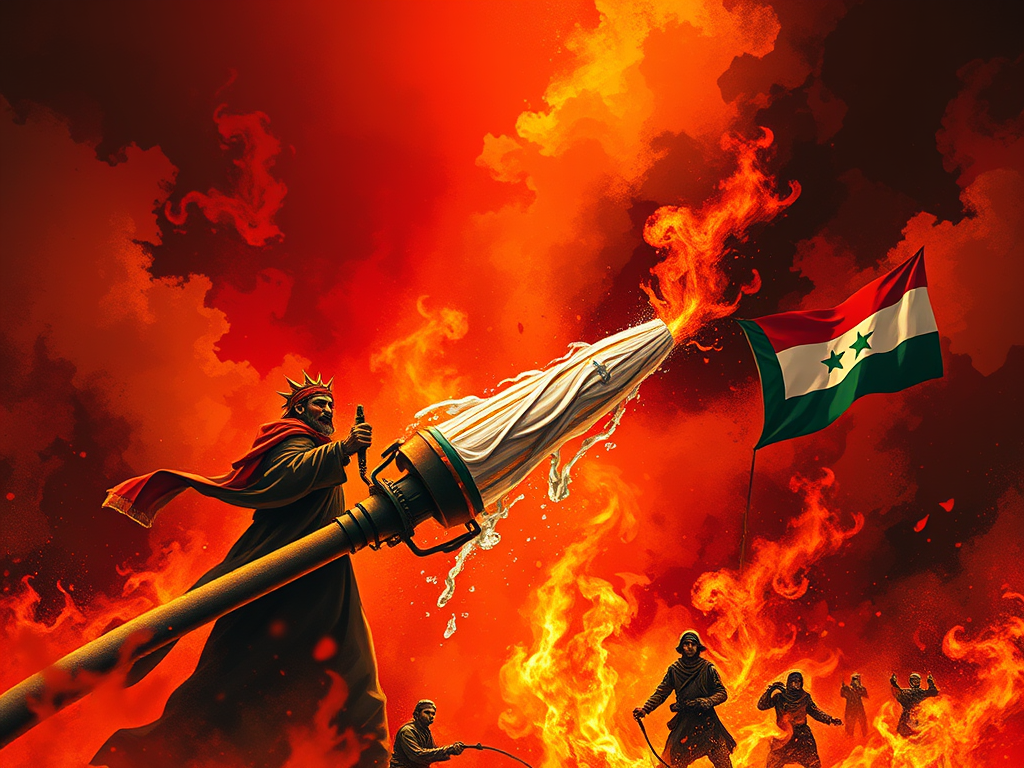
The World Is On Fire — And Arab Nations Are Holding the Hose for America
As US and Israeli bombs fall on Tehran — killing schoolgirls, obliterating diplomacy, and igniting a regional war — the Gulf Arab states perform their most shameful act yet: condemning Iran while hosting the very air bases that launched the attack.
Operation Epic Fury: How Diplomacy Was Bombed Into Silence
At 6:27 AM GMT on Saturday, February 28, 2026 — the first working day of the week in Iran, when millions of children were in school and workers were at their desks — the United States and Israel launched the largest combined military assault on a sovereign nation since the 2003 invasion of Iraq. They named it Operation Epic Fury. History may name it something else entirely.
Explosions rocked Tehran, Isfahan, Qom, Karaj, and Kermanshah simultaneously. Satellite imagery captured within hours showed destroyed compounds near the residence of Supreme Leader Ayatollah Khamenei, who — along with President Masoud Pezeshkian — was reportedly a target. The US president declared this a “major combat operation” aimed at eliminating threats, achieving regime change, and destroying Iran’s nuclear and missile capabilities. He called it “a noble mission.”
An Israeli strike hit a girls’ elementary school in broad daylight, while children sat in class. 60 more were wounded. The death toll is expected to rise. CENTCOM said it was “looking into” the reports.
The timing is not incidental. It is revelatory. Just 48 hours before the bombs fell, Oman’s foreign minister confirmed that Iran had agreed to degrade its nuclear stockpiles to the lowest level possible — effectively unrefined levels — and to accept full IAEA verification. The negotiating framework, built through three rounds of indirect Geneva talks, was the most promising diplomatic breakthrough in a generation.
Then the bombs fell.
Iran was not racing toward a bomb. Iran was in negotiations, making concessions. The strike was not a response to a threat. The strike was a response to the threat of peace.
— Editorial Analysis, February 28, 2026Iran responded with what it called an “unprecedented wave” of ballistic missiles across the Middle East — targeting US military installations in Bahrain, Qatar, Kuwait, Jordan, the UAE, and Israel. The Houthis in Yemen declared they would resume Red Sea attacks immediately. The Strait of Hormuz — through which 20% of global oil passes — became a war zone.
The Road to War: Click Each Event to Expand
Every step on this road was a choice. Click any event below to read the full analysis — and ask yourself at which point the war could have been stopped.
Operation AJAX: The CIA and British MI6 orchestrate the overthrow of Prime Minister Mohammad Mosaddegh — democratically elected, secular, nationalist — because he nationalised Iranian oil. The Shah is reinstalled. For 26 years, SAVAK (Iran’s CIA-trained secret police) tortures thousands. The 1979 Revolution is, in large part, the direct consequence of 1953. Washington planted the seed of everything that followed.
The Joint Comprehensive Plan of Action is signed by Iran, the US, UK, France, Germany, Russia, and China. Iran agrees to reduce its enriched uranium stockpile by 98%, limit centrifuges, and accept intrusive IAEA inspection. In exchange: sanctions relief. It is hailed as a landmark of international diplomacy. Iran fulfills its commitments. The deal works. Then Washington tears it up.
Despite Iran’s full compliance with JCPOA terms (confirmed repeatedly by the IAEA), Trump unilaterally withdraws the US from the agreement, reimposing and escalating sanctions. The “maximum pressure” campaign devastates the Iranian economy. Inflation soars to 40%+. The rial collapses. Ordinary Iranians — not the regime — bear the brunt. Iran begins gradually exceeding nuclear limits in response. Washington broke the deal that was working, then blamed Iran for the consequences.
A US drone strike at Baghdad Airport kills General Qassem Soleimani, commander of the IRGC Quds Force — one of Iran’s most powerful and revered military figures. Iran retaliates with ballistic missile strikes on US bases in Iraq. 110 US service members suffer traumatic brain injuries. Iran declares it will “take revenge.” The Middle East braces. The assassination removes the one Iranian commander capable of controlling proxy escalation.
Israel launches “Operation Roaring Lion” — a massive air assault on Iranian nuclear facilities at Fordow, Natanz, and Isfahan; missile production sites; military command structures; and IRGC leadership. Trump calls it “obliterated.” Iran retaliates with 550+ ballistic missiles. The US joins on June 22 — “Operation Midnight Hammer” — striking nuclear sites with B-2 stealth bombers using bunker-busting GBU-57 bombs. A ceasefire is brokered June 24. Iran’s nuclear infrastructure is damaged — but not destroyed. Iran’s will is hardened.
Economic collapse — rial at record lows, 60%+ inflation, food shortages — ignites mass protests across 100+ Iranian cities. The Norway-based Iran Human Rights group documents at least 3,428 protesters killed; US-based monitors put the figure at 6,092. Around 42,500 people are detained. Trump says “Help is on the way” — openly encouraging regime change. Washington sees an opportunity and begins preparing for a second, larger strike. The protests weaken Iran. Washington prepares to exploit that weakness.
China, Russia, and Iran formalise a trilateral strategic pact strengthening political cooperation and deepening economic integration. Chinese and Russian naval vessels deploy to the Gulf of Oman for joint exercises. China’s surveillance ships shadow the USS Abraham Lincoln Carrier Strike Group. Russia and Iran sign a $589 million deal to rebuild Iran’s air defense systems — too late to arrive before the attack. The world is choosing sides. Quietly. Then loudly.
Three rounds of indirect US-Iran talks in Geneva, mediated by Oman. Iran agrees to degrade its enriched uranium stockpile to the lowest possible level — effectively unrefined — and accept full, intrusive IAEA verification. Oman’s foreign minister calls progress “significant.” This is the most substantial diplomatic breakthrough since 2015. Iran has conceded the core demand. A deal is within reach. The bombs are already being loaded.
Coordinated US-Israeli strikes hit Tehran, Isfahan, Qom, Karaj, and Kermanshah simultaneously. Supreme Leader Khamenei and President Pezeshkian are named targets. An Israeli airstrike destroys a girls’ elementary school in Minab — 85+ children killed, 60+ wounded. Iran declares all US and Israeli assets in the Middle East “legitimate targets.” Iranian ballistic missiles strike Bahrain, Qatar, Kuwait, UAE, Jordan, and Israel. The Houthis resume Red Sea attacks. The Middle East is at war. Diplomacy is rubble.
The Arab World’s Most Shameful Performance: Condemning Iran While Hosting the Bombers
It is a performance of extraordinary moral incoherence. As US warplanes took off from bases inside Qatar, Bahrain, Kuwait, and Saudi Arabia to bomb a fellow Muslim-majority nation, the governments of those same nations rushed to microphones to condemn Iran’s retaliation. The contradictions are staggering. The silence of the Arab street — compared to the servility of Arab governments — tells the real story.
These nations publicly present themselves as defenders of Muslim dignity, Palestinian rights, and regional sovereignty. They fund mosques across the world and project soft Islamic power. Yet when the US and Israel bomb a Muslim nation in broad daylight — killing children in school — they condemn the victim’s retaliation, not the aggressor’s attack. Their populations know. Their governments calculate. The gap between the two has never been wider.
The question Arab citizens must now confront is a simple one: whose side are your governments on? When the answer is “America’s” — when the bases that launch the bombs against Muslim children are hosted on Muslim soil — the word “brotherhood” becomes a cruel joke.
The Middle East in Flames: Who Is Hitting Whom
The World After Today: Five Scenarios, Five Probabilities
What happens next is not unpredictable. History, strategic logic, and the behavior of the actors involved all point toward a range of outcomes with calculable probabilities. We assess them honestly — including the ones Western media will refuse to name.
| Scenario | Probability | Key Trigger | Global Impact |
|---|---|---|---|
| Contained Regional War — US/Israel achieve limited goals, ceasefire within 2 weeks | 22% | Iran regime collapses / accepts terms | Oil +30%, global recession risk |
| Extended Multi-Front War — Hezbollah, Houthis, Iraq factions join; war lasts months | 41% | Iran survives first wave, broadens theater | Oil +80%, shipping crisis, NATO stress |
| Russian/Chinese Intervention — Military advisors, weapons transfers escalate | 28% | Iran requests SCO assistance | Great Power confrontation, dollar collapse accelerates |
| Nuclear Threshold Crossed — Iran rushes remaining material, or tactical use threatened | 7% | Regime survival in doubt, cornered leadership | Global catastrophic risk |
| Rapid US Withdrawal / Negotiated End — Domestic pressure, casualties, Congress acts | 18% | US body bags, oil shock, Senate revolt | US credibility collapse, regional power vacuum |
Iran is not Iraq. It is not Libya. It is a nation of 90 million people, with a modern military, thousands of precision missiles, a sophisticated cyber warfare capability, and alliances stretching from Yemen to Lebanon to Iraq to the Caspian. The US military’s own wargames, leaked in 2024, showed that a sustained war with Iran — without ground invasion — ends in strategic stalemate. With a ground component, US casualties exceed Vietnam within 18 months. Iran’s leaders know this. They have prepared for this moment for decades.
The Price of Empire: How Today’s Attack Will Hit Every Wallet on Earth
Wars in the Persian Gulf are not just military events. They are economic earthquakes felt from Jakarta to Lagos to São Paulo. When the world’s most critical oil chokepoint becomes a battlefield, every nation that uses energy — which is every nation on Earth — pays the price. The citizens who will suffer most are not in Washington or Tel Aviv. They are in Dhaka, Nairobi, and Karachi.
The cruelest irony: the nations that will suffer most from this oil shock are not the aggressors. India, Japan, South Korea, and China — the world’s largest Gulf oil importers — had nothing to do with today’s decision. They were not consulted. They were not warned. The United States made a unilateral choice that will cost every Asian economy billions, potentially triggering food inflation and economic instability across the Global South.
Meanwhile, American shale producers will profit. US energy companies will see their stock prices surge. The war that kills Iranian schoolgirls will make Texas oil executives rich. This, too, is part of the strategic calculus — and it should be named plainly.
China & Russia: Between Condemnation and Complicity — The Real Game Being Played
The world is watching Beijing and Moscow. And what it sees is a performance of strategic ambiguity so carefully calibrated that it deserves its own analysis — not because China and Russia are heroes of this story, but because their choices in the coming days will determine whether today’s regional war becomes a global one.
Beijing’s Foreign Ministry issued its statement within hours: “China is highly concerned about the US and Israel’s military strikes against Iran. China calls for an immediate cessation of military operations, to avoid further escalation of tensions, to resume dialogue and negotiations, and to safeguard peace and stability in the Middle East.”
That statement is diplomatically significant — but it is also carefully bounded. China condemns the attack. China does not threaten consequences. China does not invoke its trilateral pact with Russia and Iran signed just weeks ago. China does not move its ships from surveillance posture to combat posture. China calls for ceasefire — and watches.
This is what analysts at the Middle East Institute have termed China’s “active non-alignment” — a doctrine that allows Beijing to take the moral high ground globally, build its image as a responsible power among the Global South, and accumulate long-term strategic advantage, all without firing a shot or spending a dollar on Iran’s actual defense.
Moscow was blunter. Russia’s Foreign Ministry condemned what it called an “unprovoked act of armed aggression” and accused the US of having used nuclear talks with Iran as deliberate cover before military operations. Dmitry Medvedev personally stated that America’s use of diplomacy as a deception screen was a profound violation of international norms. Russia placed “full responsibility for the negative consequences of this manmade crisis” squarely on the United States and Israel.
Russia’s Foreign Minister Lavrov spoke directly with Iran’s Araghchi, reiterating Moscow’s readiness to help broker peace while receiving Iran’s battlefield briefing. Moscow called the bombing of nuclear facilities under IAEA safeguards “unacceptable” — a pointed legal argument, given that Russia is itself a signatory to the NPT.
But here is the reality that Iran’s leadership must confront with cold clarity: Russia signed a 20-year comprehensive strategic partnership with Iran in January 2025. Russia and Iran concluded a $589 million air defense rebuild deal in December 2025. That hardware has not arrived. And Russia, as analysts from the House of Commons briefing note, is not expected to militarily defend Iran.
China and Russia have built Iran up as a partner, armed it, traded with it, and signed strategic pacts with it. Now, when the bombs fall, they offer words. Tehran’s leaders are learning the same lesson the world has always known: in the end, every nation fights alone.
— Strategic AnalysisThe Trilateral Pact — Paper Tiger or Emerging Alliance?
In January 2026, China, Russia, and Iran signed a trilateral strategic pact — strengthening political cooperation, deepening economic integration, and sending what was widely read as a deterrence signal to Washington. The timing of today’s attack — just weeks after that signing — is either a massive intelligence failure by Washington, or a calculated message: your pacts mean nothing to us.
The Middle East Institute’s analysis of China’s behaviour during the June 2025 Twelve-Day War identified what it called “significant fractures” in the supposed Russia-China-Iran axis: “China and Russia condemned Israel but offered Iran little substantive support. Russia’s reluctance to offer stronger support for Tehran, underscored by Putin’s remark that ‘Israel is almost a Russian-speaking country,’ highlighted the ambivalence at the heart of Moscow’s regional posture.”
The question being asked in every foreign ministry on earth today is whether Operation Epic Fury changes that calculus. The June 2025 strikes were limited — surgical, focused on nuclear sites. Today’s attack is different in kind: it targets the Supreme Leader personally, kills children in schools, strikes across multiple cities, and is explicitly framed as a regime-change operation. That is a different level of provocation. And it may produce a different response.
The Three Scenarios for Chinese & Russian Escalation
| Trigger | China Response | Russia Response | Global Impact |
|---|---|---|---|
| Chinese personnel killed in Iran strikes | Diplomatic rupture with US. April Xi-Trump summit cancelled. Arms deliveries accelerated. | Intelligence sharing upgraded. Possible anti-ship missile transfer to Iran. | Taiwan Strait tension spikes. Dollar sell-off. Gold +15%. |
| Strait of Hormuz closed by Iran | Emergency UNSC action. Naval escorts proposed for Chinese tankers. PLAN presence in Gulf. | Russia exploits oil price surge. Increased Arctic route cooperation. | Oil $200+/barrel. Japan, Korea, India economic emergency. Global recession. |
| Iranian regime collapses / US installs new government | Loss of $400B+ Belt and Road investment. Military doctrine revised. Taiwan timeline accelerated. | Southern flank exposed. Bosphorus access at risk. Arms exports market collapses. | SCO emergency summit. BRICS emergency reserve fund activated. De-dollarisation accelerates. |
| US strikes kill Russian military advisers in Iran | Condemns. Watches. | Red line crossed. Hypersonic missile deployment to Iran possible. Nuclear doctrine invoked. | NATO Article 5 discussions begin. Global markets suspend trading. |
| Iran requests formal SCO military assistance | Unprecedented pressure. Public debate within CCP. No military commitment but material support escalated dramatically. | Air defense systems fast-tracked. Military advisers formally embedded. | Clearest signal yet of a new bipolar world order. Dollar confidence collapses. |
China has four core interests in this conflict: (1) protecting its massive Belt and Road investments in Iran; (2) maintaining access to Iranian energy — which feeds 12% of China’s oil needs; (3) preserving its image as a sovereign-rights defender across the Global South; and (4) not triggering a direct military confrontation with the US before Taiwan is resolved. Today’s attack puts all four interests under acute stress simultaneously. Beijing’s response in the next 72 hours will be the most consequential foreign policy decision it has made since Tiananmen. If it does nothing meaningful while Iran burns — its partner, its treaty signatory — every nation in the Global South will draw a conclusion about what Chinese partnership is actually worth.
What The World Is Not Saying Out Loud
There is a sentence that no Western government will say publicly, but that every serious strategist is thinking: if China decides that the cost of allowing Iran to fall to American-engineered regime change is greater than the cost of confronting Washington directly, then today is not just the start of a Middle East war. It is the start of something that has no modern precedent.
The National Interest’s analysis of Chinese positioning noted that Trump does not want to arrive in Beijing for his April 2026 state visit “having been bested by the Islamic Republic.” But if Chinese personnel are killed in Iran, that April visit will not happen at all. And a world in which the US-China summit collapses while a war rages in the Persian Gulf and Taiwan Strait tensions spike is a world that is structurally unrecognisable from the one that existed this morning.
Russia, for its part, is learning something deeply uncomfortable: it signed a 20-year partnership with Iran, took Iran’s drones for use in Ukraine, and now watches its partner being bombed while it can offer only words and intelligence. Moscow’s credibility as a security guarantor is on the line — not just in Tehran, but in Pyongyang, in Beijing, in every capital that has considered trading Western dependency for an Eastern alternative. If Russia’s partnerships mean nothing under fire, the architecture of the emerging multipolar order is revealed as hollow.
Both powers know this. Both are calculating their next move as these words are written. And the world — held hostage to their decisions — waits.
The Verdict of History Will Not Be Kind
Let us be precise about what happened today, stripped of the euphemisms Western media will deploy in the coming hours and days.
The United States and Israel attacked a sovereign nation that was actively negotiating a peace agreement. They did so while nuclear talks were producing real concessions. They targeted a Supreme Leader in his compound. They killed 85 schoolgirls in a girls’ elementary school in a city that was not a military target. They launched this assault on a Saturday morning, deliberately timed to maximize civilian exposure. They have planned for days of strikes. And they did it unilaterally, without UN authorization, without Congressional approval, and without consulting a single ally who wasn’t already complicit.
Israel is the only nuclear-armed state in the Middle East. It attacked a nation for allegedly pursuing what it already possesses. The world must begin calling this what it is: nuclear apartheid enforced by American bombs.
— Editorial BoardThe Arab nations who host US bases and condemn Iranian retaliation are not neutral observers. They are active participants in this crime — laundering it with statements of condemnation while providing the runways, the fuel, the radar data, and the political cover that made it possible. History will record their names alongside the decision-makers in Washington and Tel Aviv.
What is being born today, in the fire and smoke over Tehran, is not a new Middle East. It is the accelerated death of an old order — one built on selective application of international law, on military dominance mistaken for moral authority, and on the servility of nations that should know better. That order is now visibly terminal. The question is only how many will die in its death throes.
The Global South is watching. Asia is watching. The world’s majority — the people who never voted for American hegemony and never consented to live under it — is watching. And it is drawing conclusions that no amount of American propaganda will be able to reverse.
The empire struck today. But empires that must bomb girls’ schools to maintain their power are empires already in their last act.