
The War That Could Break
the Petrodollar
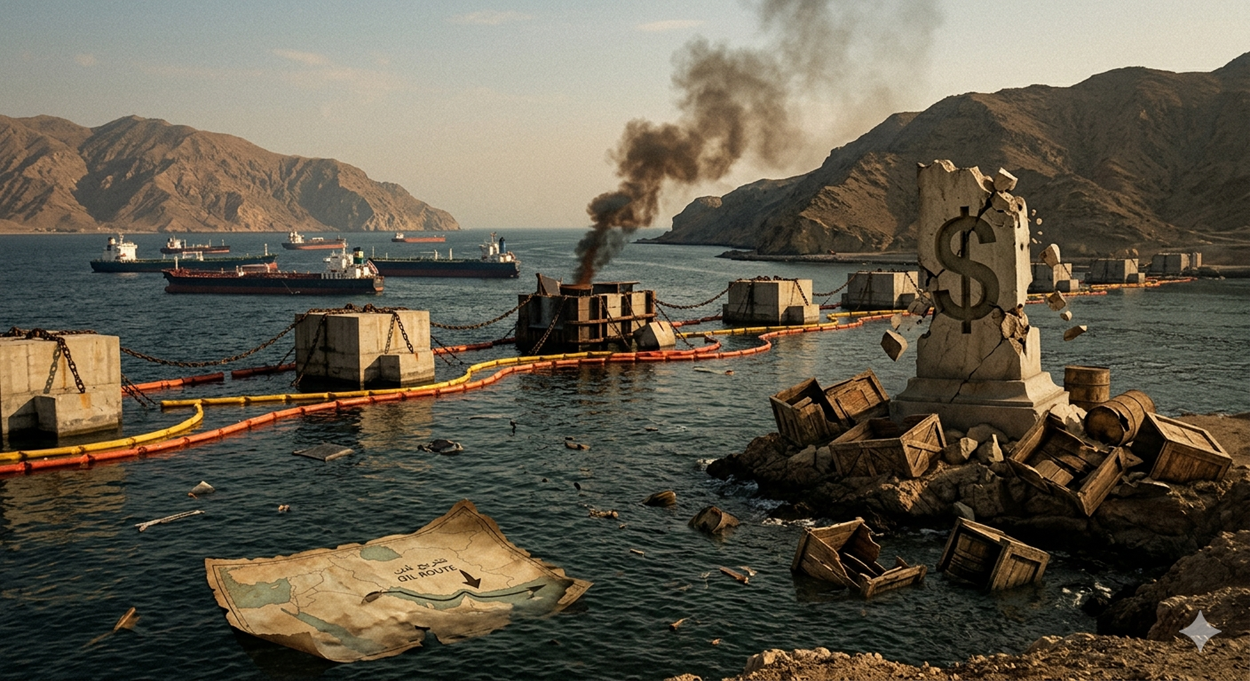
Iran’s closure of the Strait of Hormuz has disrupted one-fifth of the world’s oil supply — and opened a question that no one in Washington wants to answer: what happens when the world’s most critical energy corridor is no longer managed in dollars?
On the morning of 28 February 2026, American and Israeli warplanes struck Iran in a coordinated campaign that killed Supreme Leader Ali Khamenei and dismantled key nodes of Iran’s military infrastructure. Within hours, Iran’s Islamic Revolutionary Guard Corps had issued VHF broadcasts to every vessel in the Persian Gulf: passage through the Strait of Hormuz was no longer permitted. The message was not a bluff. Within days, tanker traffic that had been carrying roughly 20 million barrels of oil per day collapsed to near zero. Shipping giants Maersk and Hapag-Lloyd suspended their Middle East routes. Insurance premiums rose four to six times in a single week. The world’s most important energy corridor had, for all practical purposes, closed.
What followed was not only a military crisis. It was the most severe stress test the global energy system had faced since the 1973 oil embargo — and unlike 1973, it arrived in a world already quietly rearranging its financial architecture away from the dollar.
A Crisis in Fast Motion
The Chokepoint the World Built Its Economy Around
The Strait of Hormuz is 167 kilometres long and narrows at its tightest to roughly 39 kilometres. That gap — barely wider than the English Channel at Dover — is where approximately 25% of the world’s seaborne oil trade and 20% of its liquefied natural gas pass through each year. In raw tonnage, that was around 20 million barrels of crude and petroleum products per day in 2025, according to the International Energy Agency. About 80% of that was bound for Asia — predominantly China, India, Japan, and South Korea.
Bypass options exist but are painfully limited. Saudi Arabia has been diverting crude through its East–West pipeline to the Red Sea port of Yanbu; the UAE has activated its Abu Dhabi Crude Oil Pipeline to the port of Fujairah. Together, those inland pipelines have a combined capacity of roughly 8 million barrels per day — leaving a daily deficit of approximately 12 million barrels with no immediate fix. The Red Sea route, meanwhile, has its own vulnerability: the Houthis, who have already demonstrated their reach against commercial shipping.
The knock-on effects extend well beyond crude oil. All LNG from the Gulf must travel by sea through the strait. Roughly a third of global fertiliser trade passes through Hormuz, including major nitrogen exports that feed the world’s agricultural supply chains. Aluminium, petrochemicals, plastics feedstocks, pharmaceuticals, and sugar all flow through this corridor. Urea prices at the New Orleans hub have already risen from $475 to $680 per metric ton — with potentially serious consequences for spring planting across the American Midwest.
“If something goes wrong anywhere [in the global oil market], the price goes up everywhere.”
— Mark Finley, Rice University Baker Institute, on why even the world’s largest oil producer cannot insulate itself from a Hormuz closureThe Currency Dimension No One Expected
Here is where the crisis takes on a dimension that goes beyond military strategy. Vessel tracking by intelligence firms like Kpler reveals a striking pattern: while the Strait has been effectively closed to Western-aligned shipping, Iranian and Chinese-flagged vessels have continued moving through with relative ease. This is not coincidence. It reflects the contours of a selective closure — one where passage is tied, at least informally, to political and economic alignment.
Iran’s new Supreme Leader, Mojtaba Khamenei, made the strategic objective clear in his first public communication: the Strait would remain closed as a “tool of pressure.” But pressure toward what end? The selective opening — Turkish ships, Indian-flagged carriers, Saudi oil bound for India — suggests a geographic and currency logic. Countries that trade substantially in non-dollar frameworks, or that maintain independent foreign policies, appear to receive different treatment than those within the US-dollar financial orbit.
Whether Iran formally tied the reopening to yuan-based transactions or not, the effect is the same: for the first time in modern history, navigational access to the world’s most important oil corridor is being distributed based on geopolitical and financial alignment — rather than simply the law of the sea.
The petrodollar system was established in 1973–1974 when the United States and Saudi Arabia reached an agreement to price global oil trade in US dollars. In return, Washington provided security guarantees to Riyadh. The arrangement created a structural global demand for dollars: every nation that needs oil must first acquire dollars to buy it. This guaranteed demand allowed the US to run large fiscal deficits and maintain the dollar as the world’s dominant reserve currency.
Today, the dollar’s share of global foreign exchange reserves has already declined from 71% in 2008 to 56.3% as of 2025, according to IMF COFER data. Meanwhile, central banks worldwide have been purchasing over 1,000 metric tons of gold annually for three consecutive years — a sign that reserve diversification is accelerating.
The Architecture of a Rival System
The Hormuz crisis did not emerge from a vacuum. It arrived as the culmination of a decade-long, often incremental effort by a group of nations to build the financial plumbing for a world less dependent on the dollar.
Russia’s war in Ukraine and the subsequent Western sanctions in 2022 served as the most dramatic accelerant. Moscow shifted its dollar holdings from 41.5% of foreign reserves to 13–18% within two years, and began demanding payment in rubles and yuan for energy exports. China had already launched yuan-denominated crude oil futures on the Shanghai International Energy Exchange (INE) in 2018 — a mechanism that now allows significant volumes of oil to be priced and settled without a dollar transaction in sight.
As of January 2025, the petroyuan — oil settled in Chinese yuan — was already being used by Russia, Iran, Venezuela, and, in limited volumes, Saudi Arabia, the UAE, and Egypt. China’s Cross-Border Interbank Payment System (CIPS), which offers a dollar-independent alternative to SWIFT, had by then reached 1,467 indirect participants across 119 countries. Brazil and China formalised a yuan-real trade settlement agreement in 2023. India has been purchasing Russian oil in rupees. The infrastructure for a parallel financial architecture is no longer theoretical — it is operational.
| Country / Bloc | Action Taken | Implication |
|---|---|---|
| China | Yuan-crude futures (INE, 2018); CIPS payment system; yuan oil contracts with Russia, Iran, Gulf states | Building infrastructure for a petroyuan; world’s largest oil importer now partly bypassing the dollar |
| Russia | Shifted energy trade to yuan and rubles post-2022; reduced dollar reserves from ~41% to ~15% | Demonstrated rapid de-dollarisation is possible under sanctions pressure |
| Saudi Arabia | Joined BRICS; joined mBridge digital currency project; expressed openness to yuan oil payments | Most consequential potential shift — riyal pegged to dollar, but Riyadh is hedging |
| India | Purchasing Russian oil in rupees; cross-border UPI expansion with Southeast Asia | Pragmatic diversification; not ideologically anti-dollar but economically independent |
| Iran | Selective Hormuz access based on political/currency alignment; long-term yuan trade with China | First instance of a maritime chokepoint being used as a de-dollarisation pressure mechanism |
| BRICS+ (expanded) | New Development Bank; CIPS expansion; mBridge digital settlement trials; now 42% of global GDP | Building parallel financial institutions; not yet unified but growing in coordination |
Why This Moment Is Different
De-dollarisation has been declared imminent many times before. It has not happened — at least not rapidly. The dollar still accounts for approximately 80% of global oil pricing, 88% of all foreign exchange transactions, and 59% of global foreign exchange reserves. SWIFT remains the backbone of international finance. The yuan, despite rapid internationalisation, still accounts for less than 5% of global reserves. Structural inertia is real.
But this crisis has introduced something new: coercive geography. Previous de-dollarisation efforts were voluntary — nations choosing to experiment with alternative settlement mechanisms for economic or political reasons. What Iran has done is different. It has converted a physical chokepoint — one that cannot be bypassed, duplicated, or replaced within any useful timeframe — into a lever that rewards non-dollar alignment and punishes dollar-centric economic structures.
The IEA’s unprecedented 400-million-barrel reserve release, the US administration’s confused messaging on whether the Navy can or will escort tankers, and Trump’s own public encouragement for vessels to “show some guts” and transit the strait — all of this signals that Washington does not yet have a coherent answer to a strategy it did not anticipate.
“The strategic objective is to inflict as much punishing pain as necessary — on US military bases, the Israeli homeland, Gulf countries, and indirectly the US homeland.”
— Farzin Nadimi, analyst, speaking to CNN on Iran’s strategic calculusThe Ripple: From Africa to Asia
The countries feeling the most acute pain are not the United States or Europe. Japan imports approximately 70% of its oil through the Strait of Hormuz. South Korea and India have scrambled to find alternative routes or renegotiate supply. Pakistan, heavily dependent on Gulf imports, has officially requested Saudi Arabia reroute oil via the Red Sea port of Yanbu. Japan’s refiners, who source 95% of crude from the Gulf, have requested government release of strategic stockpiles.
In the medium term, the crisis reshapes a map that was already changing. Across Africa, a generation of economies has been deepening trade with China and India, building infrastructure through Belt and Road partnerships, and developing commodity trade relationships that bypass Western intermediaries. A sustained dollar crisis accelerates that shift — reducing the cost of settling trade in yuan or local currencies relative to the dollar system.
For nations under US sanctions — Venezuela most prominently — an erosion of the petrodollar’s dominance is not merely an economic preference but a survival mechanism. If major oil producers increasingly accept yuan and other currencies, the financial leverage that makes sanctions effective diminishes. The weapons and the targets change simultaneously.
The Limits of the Challenge
Intellectual honesty requires acknowledging what this crisis cannot, on its own, accomplish. The yuan’s structural limitations are real. China’s capital controls restrict international investors’ confidence in the renminbi. Unlike the dollar — which enjoys deep, liquid, legally transparent financial markets — yuan-denominated assets remain less accessible to foreign institutional investors. There is no mechanism yet for oil-exporting countries to efficiently recycle yuan surpluses into productive financial instruments the way petrodollars were recycled through the Eurodollar market and US Treasury purchases.
BRICS also lacks the internal coherence to function as a unified financial bloc. India and Brazil remain cautious about deeper yuan integration, given their strong economic ties with Western financial institutions. Saudi Arabia, whose riyal has been pegged to the dollar since the 1980s, cannot easily de-peg without major macroeconomic consequences.
The most likely trajectory — crisis or no crisis — is not a sudden replacement of the dollar but a gradual multi-currency world, in which oil is priced and settled in a mix of dollars, yuan, euros, and potentially regional currencies. Historians of monetary systems note that the transition from sterling to the dollar took decades even after Britain’s economic primacy was clearly over. Currency transitions are slow.
The Question That Remains
What the 2026 Hormuz crisis has done — regardless of how the military conflict ends — is transform an abstract structural question into a concrete and urgent one. The question is no longer whether the petrodollar system faces long-run pressure. That has been evident for years. The question is whether a physical act of control over a maritime chokepoint can force countries to accelerate choices they were already, slowly, making.
Iran, outgunned and under existential military pressure, has answered a question about leverage that no sanctions regime, no BRICS summit, and no yuan futures contract could answer alone: that the geography of energy still matters, and that whoever controls the geography of energy can — at least temporarily — control the terms on which the world economy operates.
If the Strait reopens quickly and the old order reasserts itself, the petrodollar survives this crisis and the structural drift continues at its slow pace. But if the closure persists, if selective passage in yuan-aligned shipping becomes a lasting norm, or if the political settlement that ends this war includes implicit concessions on how Gulf energy is priced and settled — then historians may mark February 2026 not merely as the month a war began, but as the moment the dollar’s half-century reign over the world’s energy markets entered its final, uncertain chapter.