
THE PAPER
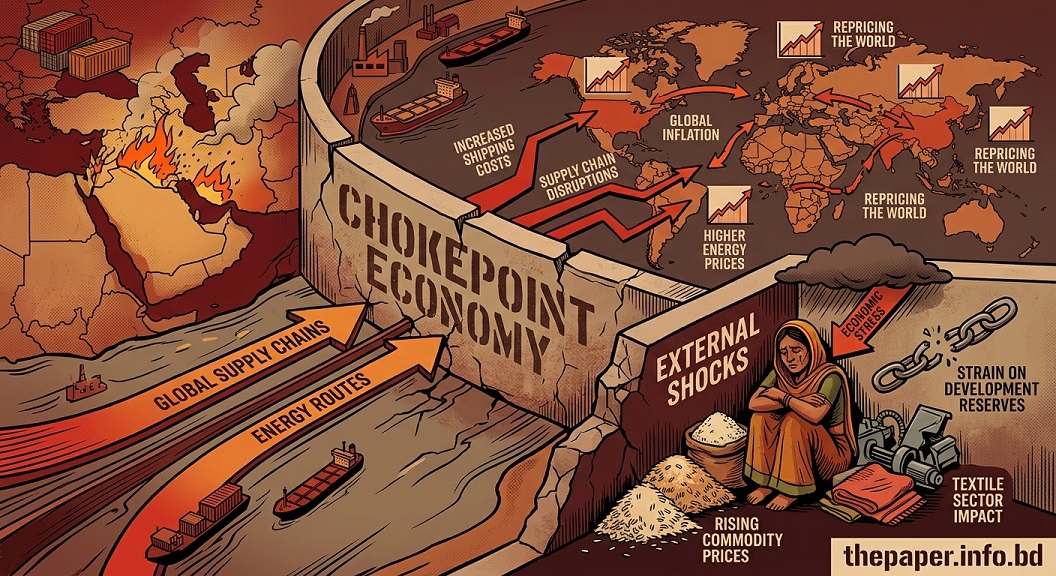
The Chokepoint Economy: How the Middle East War Is Repricing the World — and Cornering Bangladesh
Seven months after the Strait of Hormuz went dark, the conflict has stopped being a Gulf story. It is now a balance-of-payments story for every fuel-importing economy on earth — and nowhere is that arithmetic tighter than in Dhaka.
The world has been here before — 1973, 1979, 1990 — but never quite like this. Since Israeli and American strikes on Iran opened hostilities on 28 February 2026, the Strait of Hormuz, the 21-mile funnel through which a fifth to a quarter of the world’s seaborne oil and roughly a fifth of its liquefied natural gas normally passes, has spent most of the year somewhere between crippled and closed. Tanker traffic through the strait collapsed from an average of 129 vessels a day in February to four by 10 March — a 97 percent evaporation of the world’s most important energy corridor in under two weeks. Seven months on, with Houthi forces opening a new front against Riyadh and an Iranian pipeline in the east shut down as recently as 11 September, the crisis has not resolved. It has metastasised — into oil markets, into shipping insurance, into fertiliser and food prices, and, for import-dependent economies like Bangladesh, into the current account itself.
A war that will not stay contained
The conflict’s arc has been anything but linear. Brent crude jumped roughly 65 percent in March, its steepest monthly rise in history, before easing on ceasefire hopes; it has since whipsawed between roughly $70 and above $100 a barrel depending on the week’s headlines, with the U.S. Dallas Fed modelling a WTI price near $98 a barrel under a sustained closure scenario and a corresponding 2.9-percentage-point hit to annualised global growth. A U.S.-Iran memorandum in June briefly cooled tensions, only for Iran to resume tanker attacks in Omani waters in July, prompting renewed American strikes and another declared closure of the strait. By September, the fighting had widened rather than narrowed: Houthi forces in Yemen — opening what analysts now call a genuine second front — have displaced more than 100,000 people and, for the first time in the current escalation, fired a ballistic missile at Riyadh itself. Syria is seeing fuel-price protests, Bahrain’s Shia community is in sustained unrest, and targeted killings have risen in Iranian Kurdish regions. At the United Nations General Assembly this week, Qatar’s Emir publicly called for the strait to reopen, while the U.S. president has signalled a possible deal with Iran alongside warnings of severe consequences should talks fail. Nobody with authority over the strait is yet promising an end date.
The chokepoint economy: oil, gas and the price of insuring a ship
The direct commodity shock is only half the story trade financiers are living through. The other half is insurance — and it is arguably the more structurally important one, because insurance, not the cargo itself, is what makes a documentary credit bankable in the first place. Before February, a seven-day war-risk policy for a Gulf transit cost a shipowner roughly a quarter of one percent of the vessel’s hull value. Within 48 hours of the first strikes, that had risen fivefold. By July, brokers were quoting war-risk premiums of three to ten percent of hull value — meaning a $100 million tanker now carries a war-risk bill of $3 million to $10 million for a single voyage, against roughly $250,000 before the war. Fitch Ratings has recorded spikes of up to twenty times pre-war levels on the most exposed routes. The International Group of P&I Clubs, which underwrites roughly 90 percent of the world’s ocean-going tonnage, moved to give itself 72-hour cancellation rights on war cover — an extraordinary tightening for a market built on multi-year continuity.
That repricing does not stay with shipowners. It is passed to charterers, to cargo interests, and ultimately into freight rates, letter-of-credit costs and the landed price of everything from crude to fertiliser to grain. Kuwait Petroleum Corporation has already invoked force majeure to cut output. Governments have started stepping in as insurers of last resort: Washington’s Development Finance Corporation has assembled a reinsurance facility offering up to $40 billion in revolving hull, cargo and liability cover, while India has built a $1.5 billion sovereign guarantee programme alongside a $300 million industry claims fund simply to keep its own shipping and trade flows moving. For trade finance desks structuring LCs against Gulf-linked cargo, war clauses, force majeure provisions and sanctions-adjacent compliance checks — once boilerplate — have become the substantive part of the negotiation.
Energy markets: the gas shock is outrunning the oil shock
Natural gas has, if anything, been hit harder than crude. Roughly a fifth of global LNG trade also transits Hormuz, and Asian spot LNG prices spiked more than 140 percent after strikes on export infrastructure that the IEA estimates will take three to five years to fully repair. The World Bank’s Commodity Markets Outlook describes the resulting hit to global oil supply — a 10.1 million barrel-a-day crash in March alone — as the largest in the history of the oil market, with global output on track for its steepest quarterly decline since the pandemic. Fertiliser prices have risen in tandem, since Gulf gas feeds a large share of the world’s ammonia and urea capacity; grain prices had, as of the most recent assessments, not yet followed — but analysts caution that sustained energy and fertiliser inflation will eventually work through into food production costs everywhere, including South Asia.
Bangladesh’s reckoning
For a country that imports roughly 90 percent of its fuel from the Middle East, this is not a distant war. It is a direct hit to the current account. Bangladesh spends close to $1 billion a year importing more than six million tonnes of crude and refined petroleum products, the overwhelming majority sourced from Saudi Arabia, Kuwait and the UAE and shipped through the very strait now functioning at a fraction of capacity. Analysis from Zero Carbon Analytics puts the likely additional cost to Bangladesh’s annual fossil-fuel import bill at roughly $2.8 billion in 2026 if oil, gas and coal prices hold near their year-to-date average — a sum equivalent to about a tenth of the country’s entire 2025–26 trade deficit. The same analysis estimates the import-cover ratio — months of imports the country could pay for from reserves alone — sliding from 5.7 months before the crisis to roughly 5.2 months now.
| Indicator | Pre-crisis / baseline | Current trajectory |
|---|---|---|
| Fuel import dependence on Middle East | — | ~90% of national fuel imports |
| Annual petroleum import bill | ~US$1 billion (6M+ tonnes) | Fossil-fuel bill up an est. US$2.8bn in 2026 |
| LNG imports, Jan–Aug | 2025 baseline | ~13% lower y/y; Jul–Aug alone down ~83% |
| Import cover ratio | 5.7 months | ~5.2 months |
| GDP growth (FY26) | Pre-war forecasts higher | World Bank: slowing to ~3.9%; ADB regional: 4.7% |
| Regional inflation (ADB, developing Asia) | — | Rising toward ~5.2% |
The squeeze shows up first in the power sector. LNG imports between January and August 2026 ran roughly 13 percent below the same period last year, with the single steepest drop — nearly 83 percent — between July and August, as Bangladesh was repeatedly outbid on the volatile spot market. The result has been widespread load-shedding, mandated power-saving measures and curtailed industrial output, even as the government has had to turn to India, the United States and other diversified sources to plug the gap. Dhaka is reported to be spending an additional $1.07 billion on LNG subsidies in the April–June quarter alone — money that widens the fiscal deficit precisely as external financing has become more expensive.
Gulf Cooperation Council countries account for roughly half of all remittances into Bangladesh, with Saudi Arabia alone contributing an estimated $430 million a month. Those inflows are not just household income; the government relies on remittance-driven foreign exchange to finance an estimated 47 percent of the country’s import payments. Any sustained disruption to Gulf labour markets — whether through economic slowdown, project cancellations, or workers being sent home — would remove one of the main shock absorbers that has historically kept both the currency and low-income households stable.
Trade flows have felt it too. Multiple Gulf carriers — Qatar Airways, Kuwait Airways and Oman Air among them — have at various points suspended cargo operations out of Dhaka, leaving ready-made garment shipments, the country’s largest export earner, stranded at Hazrat Shahjalal International Airport; more than 1,200 tonnes of RMG cargo were reported stuck at one point this year. Ocean carriers, including Mediterranean Shipping Company, paused new bookings on Middle East-bound routes altogether. For an export sector that runs on tight delivery windows and documentary-credit timelines, that kind of logistics freeze is as damaging as the tariff and cost shocks themselves — shipments delayed past their LC expiry or shipment deadline can void the credit entirely, forcing costly amendments or discounting at the exporter’s expense.
The human accounting is stark. The International Growth Centre estimates the crisis has already pushed as many as 1.2 million Bangladeshis into poverty, driven by the combination of fuel-price pass-through, transport cost inflation and squeezed real incomes. Reporting from Dhaka’s informal transport sector — ride-share drivers weighing a return to their home villages as fuel costs outrun what city work can support — illustrates a broader pattern the World Bank and ADB have both flagged: a prolonged Gulf conflict does not just move macro indicators, it reshapes where and how people can afford to live.
What trade financiers are watching next
For banks structuring corporate credit and trade finance facilities into or through the Gulf corridor, three variables now sit above almost everything else in the risk conversation. First, insurance availability and cost: with war-risk cover this volatile, documentary credits touching Gulf-linked shipping increasingly need explicit war and force majeure clauses, and pricing needs to assume premiums can move by multiples within a single quarter. Second, currency and reserve adequacy: Bangladesh Bank’s ability to defend the taka depends directly on how the import-cover ratio moves from here, which in turn depends on both the oil price path and remittance resilience. Third, diversification: the World Bank, ADB and IGC are converging on the same prescription — accelerating renewable capacity, broadening the tax base to fund targeted rather than blanket fuel subsidies, and diversifying migrant labour markets toward Southeast Asia and Europe so that a single region’s war cannot single-handedly move Bangladesh’s balance of payments.
None of that is quick to build. In the meantime, every extra week the Strait of Hormuz functions at a fraction of capacity is a week in which fuel subsidies grow, reserves thin, and the margin for absorbing the next shock — whatever it turns out to be — narrows a little further.