
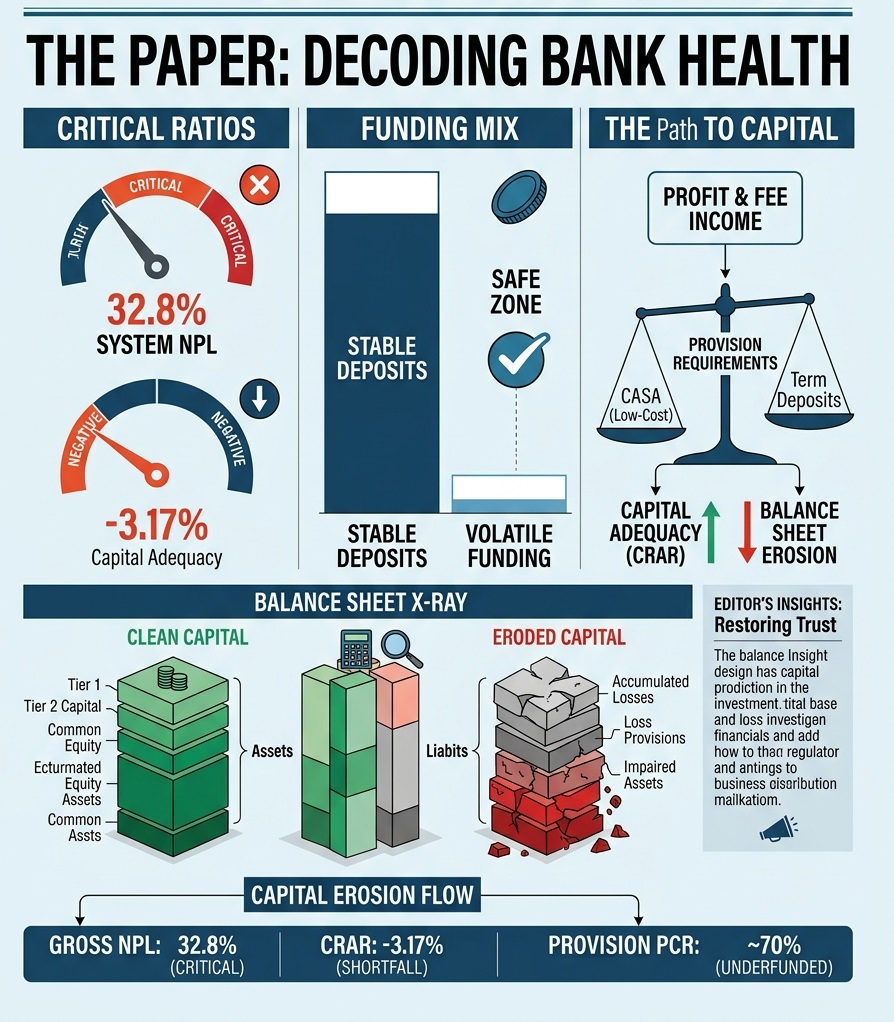
The Balance Sheet Lie
How to read a bank’s numbers so you can tell a healthy institution from one that is only dressing the windows. A practical guide for depositors, local banks and anyone who still believes capital, asset quality and funding stability matter.
1 · The four diseases that destroy banks
Every major banking failure of the last forty years can be traced to one or more of these patterns. Bangladesh is living through all four at once.
Window dressing
Temporary cosmetic surgery before reporting dates: rescheduling loans so they look “performing,” under-provisioning, year-end balance-sheet compression, or classifying bonds as Hold-to-Maturity to hide mark-to-market losses.
IMF has criticised immediate reclassification of restructured loans in Bangladesh
Rate & maturity mismatch
Funding long-term, fixed-rate assets with short-term, rate-sensitive deposits. When rates rise or depositors flee, funding cost explodes while asset yields stay locked. Silicon Valley Bank was the purest recent example; the same risk sits inside many Bangladeshi banks.
Unhealthy competition
Too many banks chasing too few good borrowers. Sixteen new licences in fifteen years, many under political pressure, produced capital dilution, relationship lending and a race to the bottom on underwriting standards.
Governance capture
Boards and management serving political or business-group interests instead of depositors. Connected lending, weak collateral, repeated rescheduling, and the eventual concentration of 72% of all NPLs inside ten institutions.
How the diseases reinforce each other
Once capital is eroded, the bank has less capacity to absorb further losses, so the pressure to window-dress increases. The cycle continues until an independent review or a funding run forces recognition.
2 · The depositor’s 7-ratio checklist
You do not need an accounting degree. These seven numbers appear in every bank’s annual report, quarterly financials and Bangladesh Bank disclosures. Together they form a reliable early-warning system.
| Ratio | What it tells you | Healthy zone | Danger zone |
|---|---|---|---|
| Capital Adequacy (CRAR) | Buffer to absorb losses before depositors are hit | ≥ 12.5% (Basel III + buffer) | < 10% or falling; negative is critical |
| Gross NPL ratio | % of loans 90+ days past due or impaired | < 5% (ideally < 3%) | > 10% and rising; > 20% = systemic stress |
| Provision Coverage (PCR) | % of NPLs already covered by provisions | > 70–80% | < 50% while NPLs climb = hidden losses |
| Loan-to-Deposit (LDR) | How much of deposits are already lent out | 70–90% | > 95–100% = heavy wholesale funding |
| Net Interest Margin (NIM) | Core profitability of the lending book | > 2.5–3% | Falling sharply or negative |
| Return on Assets (ROA) | Overall efficiency of the balance sheet | > 1% | Consistently < 0.5% or negative |
| CASA ratio | % of low-cost current & savings deposits | > 40–45% | Low and declining = expensive, flighty funding |
3 · The balance-sheet X-ray: what a buyer or depositor should ask
Whether you are a depositor choosing where to keep money, or a local bank evaluating a portfolio, the same questions apply. Gross size is almost never the right number.
Real bank economics
Interest income + fees − funding cost − operating cost − collection cost − ECL / provisions − capital cost = risk-adjusted economic return
| Area | Questions that actually matter |
|---|---|
| Asset quality | Gross & net NPL, SMA/PAR, 30/60/90+ day buckets, roll rates, cures, vintage performance, restructured loans that later re-default |
| Provisioning honesty | PCR trend, provision shortfall, whether rescheduled loans are immediately treated as performing |
| Capital | CRAR trajectory, CET1 quality, capital shortfall relative to risk-weighted assets, stress under a 3–5% further NPL rise |
| Funding | CASA vs term, deposit concentration, rate sensitivity, reliance on interbank or central-bank facilities |
| Maturity gap | ALM gap table by bucket; large negative cumulative gaps in the 1–3 year range are dangerous |
| Concentration | Top-20 borrowers, single-group exposure, sector concentration, related-party lending |
| Profitability quality | NIM trend, fee income sustainability, cost-to-income, whether “operating profit” is being propped up by under-provisioning |
| Governance signals | Frequency of board changes after regulatory intervention, qualified audit opinions, repeated Bangladesh Bank observations |
Before you trust a low NPL number…
Ask how much of the book has been rescheduled in the last 24 months and how those loans are classified. Bangladesh Bank’s earlier rules allowed immediate reclassification of restructured exposures as performing — a practice the IMF explicitly criticised for masking underlying asset quality. A low headline NPL can coexist with a large stock of loans that are not generating cash.
Before you trust a strong capital number…
Check whether the bank has a material provision shortfall. Capital that has not yet absorbed known losses is not real capital. Also examine the quality of capital (CET1 versus weaker instruments) and whether risk-weighted assets themselves look understated.
Before you trust a high deposit base…
Separate CASA from high-cost term deposits. Rate-sensitive term money can leave quickly when confidence or alternative yields shift. Look at deposit concentration: a few large depositors create run risk even if the headline CASA looks healthy.
4 · Bangladesh 2026 — the numbers that matter
After years of regulatory forbearance, independent asset-quality reviews and stricter classification standards have forced recognition of losses that were previously carried as “performing” or only lightly provisioned.
5 · Global lessons — the same movie, different countries
Bangladesh’s scale is extreme, but the mechanisms are universal.
| Episode | Core failure | Balance-sheet signal that was visible |
|---|---|---|
| Silicon Valley Bank (2023) | Maturity mismatch + uninsured deposits + HTM accounting that hid unrealised losses | Long-duration bonds funded by flighty deposits; rapid deposit growth; rising mark-to-market losses |
| US Savings & Loan crisis (1980s) | Long fixed-rate mortgages funded by short-term deposits when rates rose | Negative ALM gaps; collapsing net interest margin |
| Lehman Brothers (2008) | Extreme maturity mismatch + leverage + off-balance-sheet vehicles | Overnight funding of long, illiquid assets; high leverage |
| European G-SIB window dressing | Year-end compression of derivatives and repo books to lower systemic scores | Sharp quarter-end drops that reverse immediately after the reporting date |
| Bangladesh 2015–2026 | Political lending + rescheduling forbearance + over-banking + weak governance | Rising NPLs + falling PCR + negative CRAR + extreme concentration of large exposures |
6 · The practical 10-minute health check
Use this sequence every time a new quarterly or annual report appears.
- Capital first. Find CRAR. Is it above 12.5%? Is the four-quarter trend rising or falling?
- Asset quality. Gross and net NPL. Compare with the previous year. Has a large stock of previously “restructured” loans been reclassified?
- Provisioning honesty. PCR. Below 60–70% while NPLs are climbing is a classic window-dressing flag.
- Funding stability. LDR and CASA. High LDR + low CASA = vulnerable to a deposit run.
- Profitability quality. NIM and ROA. Declining NIM often signals mismatch pain or non-performing assets that no longer earn interest.
- Concentration & related parties. Top-20 borrowers and related-party notes. Extreme concentration is how single-group failures sink banks.
- Liquidity & ALM gap. Maturity gap table. Large negative cumulative gaps in short-to-medium buckets are dangerous when rates or confidence shift.
- Auditor & regulator signals. Qualified opinions, emphasis-of-matter paragraphs, or repeated Bangladesh Bank observations are never “just technical.”
- Peer comparison. Rank the bank against the better-performing private banks on the same ratios. Relative weakness is often clearer than absolute levels.
- Trend, not snapshot. One good quarter can be window dressing. Four consecutive quarters of deterioration rarely is.
7 · What local banks should do (and not do)
Build the opportunity
✓ Prefer capital strength and honest provisioning over headline growth.
✓ Price credit according to risk and expected loss, not relationship pressure.
✓ Strengthen behavioural scoring, collections and fraud analytics.
✓ Treat customer lifetime value (salary → cards → loans → wealth) as the real asset.
✓ Prepare for full IFRS 9 / ECL — forward-looking loss recognition changes portfolio economics.
Control the downside
✗ Do not buy portfolios for size alone.
✗ Do not assume foreign-bank customers are automatically low-risk.
✗ Do not treat rescheduled loans as cured until cash is actually flowing.
✗ Do not ignore capital consumption and integration cost.
✗ Do not wait for formal NPL classification to recognise deterioration under ECL.
| Do | Do not |
|---|---|
| Conduct independent due diligence on any acquisition | Buy for headline asset growth |
| Analyse each product and vintage separately | Rely only on current NPL classification |
| Stress-test ECL and deposit attrition | Assume deposits stay cheap and sticky |
| Measure customer lifetime value | Treat a loan balance as the whole relationship |
| Invest in collections and fraud controls | Depend exclusively on collateral |
| Plan technology and data migration carefully | Underestimate integration and service continuity cost |
8 · Bottom line
Bangladesh’s banking crisis is the delayed recognition of decisions made over more than a decade: politically influenced lending, repeated rescheduling that postponed loss recognition, an excess of banks competing for limited good assets, and chronic mismatches between the maturity and rate structure of assets and liabilities.
The same tools that finally revealed the damage also identify the survivors. Banks that maintained high-quality capital, conservative underwriting, honest provisioning and stable low-cost deposits continue to stand out against the sector averages.
For local banks: The opportunity is not to become bigger by absorbing weak portfolios. It is to become better at selecting, pricing, monitoring and recovering credit while turning quality relationships into sustainable value.
For policymakers: End forbearance that masks losses, force honest classification and provisioning, consolidate the weakest institutions, and restore governance that serves depositors rather than connected borrowers.
In modern banking the balance-sheet size is visible. The quality of the balance sheet is where the real value — or the real loss — sits. Window dressing can buy time. It cannot create capital or collect cash from a defaulted borrower.
Sources & methodology
- Bangladesh Bank: Financial Stability assessments and published NPL, CRAR and provision data through mid-2026 (sector NPL ~32.8%, CRAR negative, capital shortfalls at 21 banks, provision shortfall > Tk 2.22 lakh crore).
- World Bank & IMF assessments: commentary on asset-quality recognition, regulatory forbearance, and the move toward tighter classification standards.
- Public reporting: concentration of NPLs in a small number of institutions; merger processes for several Islamic banks; relative performance of stronger private banks.
- Global comparators: Silicon Valley Bank (2023) post-mortems on maturity mismatch and HTM accounting; BIS/ECB studies on G-SIB year-end window dressing; historical literature on the US Savings & Loan crisis and Lehman’s funding structure.
- IFRS 9 / ECL: Bangladesh Bank roadmap targeting fuller expected-credit-loss implementation by end-2027 — relevant for any forward-looking valuation of loan books.