
When Global Banks Retreat from Retail
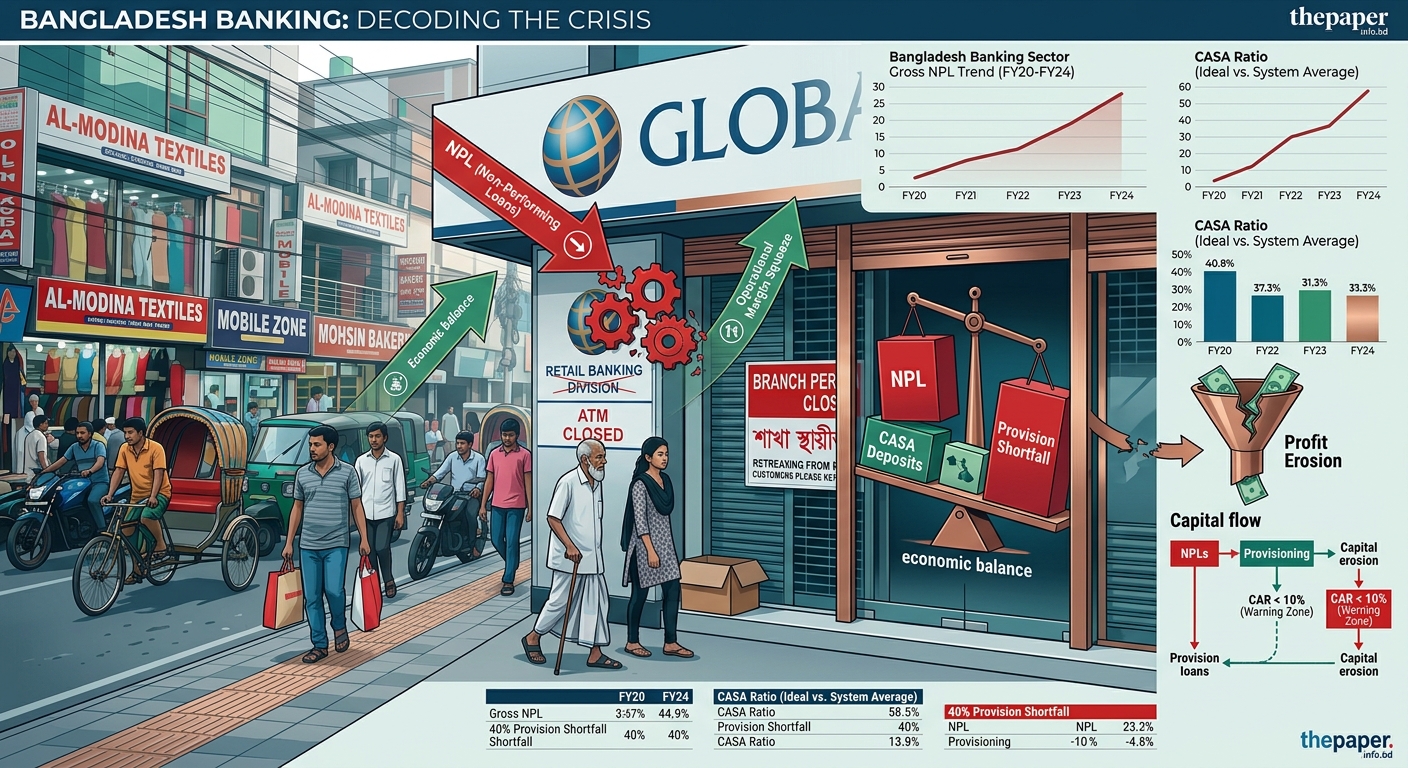
HSBC is winding down its retail banking business in Bangladesh. Standard Chartered is reported to be preparing to sell its retail portfolio. For local banks, the opportunity is real—but so is the risk hidden behind the headline numbers.
1 · Two exits—but not the same story
HSBC
HSBC announced in July 2025 that it would wind down its International Wealth and Premier Banking (Retail Banking) business in Bangladesh. It stopped accepting new retail customers and began a phased wind-down.
AnnouncedWind-down underwayCIB retainedStandard Chartered
Bangladeshi media reported in September 2026 that Standard Chartered was preparing to sell its retail banking portfolio. Local banks have reportedly shown interest, but a final transaction has not been announced.
Reported sale processPreliminaryCorporate business retained2 · Why are global banks narrowing retail?
It is tempting to read the moves as a verdict on Bangladesh. The documented explanations are more nuanced.
HSBC said its decision followed a review of its relative market position and strategic fit and formed part of the group’s wider simplification strategy. Standard Chartered’s global strategy has increasingly emphasised corporate and institutional banking, cross-border connectivity and affluent wealth management.
The global strategic shift
For an international bank, mass retail requires a large domestic operating machine: branches, cards, ATMs, customer service, collections, fraud controls, compliance and local product management. Cross-border corporate banking and wealth management can offer a different economics and strategic fit.
That does not prove Bangladesh retail banking is unattractive. It means the economics must be evaluated from the perspective of each institution.
3 · The number that can fool a buyer
Suppose a bank is offered a retail portfolio worth thousands of crore taka. The headline asset size is impressive. But asset size is not economic value.
Real retail-bank economics
Interest income + fees − funding cost − operating cost − collection cost − ECL − capital cost = risk-adjusted economic return
A buyer should therefore ask not merely “How much is the portfolio?” but “What will the portfolio earn after all foreseeable costs and losses?”
4 · Bangladesh changes the calculation
5 · ECL changes the game
Bangladesh is moving from a traditional provisioning framework toward IFRS 9 Expected Credit Loss. Bangladesh Bank’s roadmap provides for phased implementation, with full implementation targeted for December 2027.
This makes portfolio acquisition more demanding. A buyer needs to understand the future loss profile, not just the current classification status.
6 · The portfolio X-ray
| Area | Questions the buyer should ask |
|---|---|
| Asset quality | NPL, SMA/PAR, 30/60/90+ day buckets, roll rates, cures and vintage performance |
| Customer quality | Mass retail, salary customers, affluent customers, self-employed borrowers and concentration |
| Deposits | CASA versus term deposits, pricing, stickiness and rate sensitivity |
| Profitability | Product-level NIM, fees, operating cost, collection cost and capital consumption |
| ECL | Existing provision plus forward-looking expected losses under adverse scenarios |
| Technology | Core banking, cards, CRM, data migration, cyber controls and service continuity |
| Collections | Actual recovery rates, write-offs, legal recovery and collection productivity |
| Fraud | KYC quality, application fraud, employee-assisted fraud, card fraud and identity risk |
7 · Would you buy this portfolio?
This is where the story becomes more interesting. Imagine a portfolio containing:
Tk8,000cr depositsConsumer loansCredit cardsSalary accountsHome loansAffluent customers
Would you buy it?
Before answering, check the deposit side
Tk8,000 crore of deposits can be highly valuable if much of it is stable, low-cost CASA funding. The same headline amount can be much less attractive if it is predominantly rate-sensitive term funding that reprices quickly.
Now check the loan side
Break the book into product, vintage, delinquency, borrower segment and geography. Look for early arrears and deterioration trends rather than relying only on current NPL classification.
Now check the customer relationship
A salary account may lead to cards, home loans, investments, remittances and wealth products. Customer lifetime value can therefore exceed the economics of the initial loan.
Finally, check capital
Determine the incremental risk-weighted assets, capital requirement, ECL impact and integration cost. A portfolio can be profitable at the product level and still be unattractive after capital consumption.
8 · The hidden value: relationships
A retail customer is not just a loan account.
A disciplined bank can build multiple revenue streams around a customer relationship. That is one reason a portfolio transaction should be evaluated on customer lifetime value, not simply loan outstanding.
9 · Governance: the issue that cannot be ignored
Bangladesh’s banking problems are not limited to large corporate connected lending. Retail portfolios can also carry operational and fraud risks: weak KYC, fake income documentation, identity manipulation, multiple borrowing, card fraud, employee collusion and weak collections.
Bangladesh Bank has linked the deterioration of asset quality to factors including imprudent lending and weak oversight. That makes governance and control quality a core part of any portfolio-transfer due diligence.
10 · What should local banks do?
Build the opportunity
✓ Use acquisitions to gain quality customers, not just balances.
✓ Strengthen affluent and wealth propositions.
✓ Use behavioural credit scoring and transaction data.
✓ Improve digital onboarding and customer service.
Control the downside
✓ Price credit according to risk.
✓ Stress-test ECL and deposit attrition.
✓ Strengthen collections and fraud analytics.
✓ Treat capital consumption as a transaction cost.
11 · The local-bank playbook
| Do | Do not |
|---|---|
| Conduct independent due diligence | Buy for headline asset growth |
| Analyse each product separately | Assume all foreign-bank customers are low-risk |
| Measure customer lifetime value | Assume deposits are permanently cheap |
| Build forward-looking ECL models | Wait for NPL classification to recognise deterioration |
| Invest in collections and fraud controls | Depend exclusively on collateral |
| Plan technology migration carefully | Underestimate integration cost |
12 · What customers should watch
For customers, the key issue is continuity rather than the headline transaction.
Watch for changes in account servicing, cards, fees, loan repayment channels, digital access, branch/ATM availability and product terms. HSBC’s ongoing wind-down illustrates why customer migration and closure procedures can occur in stages rather than overnight.
13 · Bottom line
HSBC’s retail wind-down and Standard Chartered’s reported retail portfolio sale are part of a broader strategic shift by global banks toward areas where they believe they have stronger competitive or network advantages. Both institutions continue to maintain important corporate/institutional activities in Bangladesh.
For Bangladesh’s local banks, however, the development arrives at a difficult time: high NPLs, subdued private credit, elevated funding costs, governance weaknesses and the transition toward forward-looking ECL all make careless balance-sheet expansion more dangerous.
It is to become better at selecting, pricing, monitoring and recovering retail credit—while turning quality customer relationships into sustainable long-term value.
In modern banking, the portfolio size is visible. The quality of the portfolio is where the real value—or the real loss—sits.
Sources & methodology
- HSBC Bangladesh, July 2025: official announcement of the phased wind-down of International Wealth and Premier Banking in Bangladesh and continuation of CIB.
- HSBC Bangladesh: current customer notices describing the phased wind-down and service/account closure process.
- The Business Standard, September 2026: reporting on Standard Chartered Bangladesh’s proposed retail portfolio sale and reported portfolio size.
- Bangladesh Bank: Financial Stability Report 2025; Monetary Policy Review 2025-26; H1 FY27 Monetary Policy Statement and NPL-management roadmap.
- Bangladesh Bank: IFRS 9 / Expected Credit Loss implementation roadmap and Annual Report 2024-25 discussion of ECL.
- Standard Chartered: public strategy and annual-report materials describing its focus on corporate/institutional banking, cross-border capabilities and wealth management.